
This is the Third Article in ‘You+AI” series. Last article can be accessed here
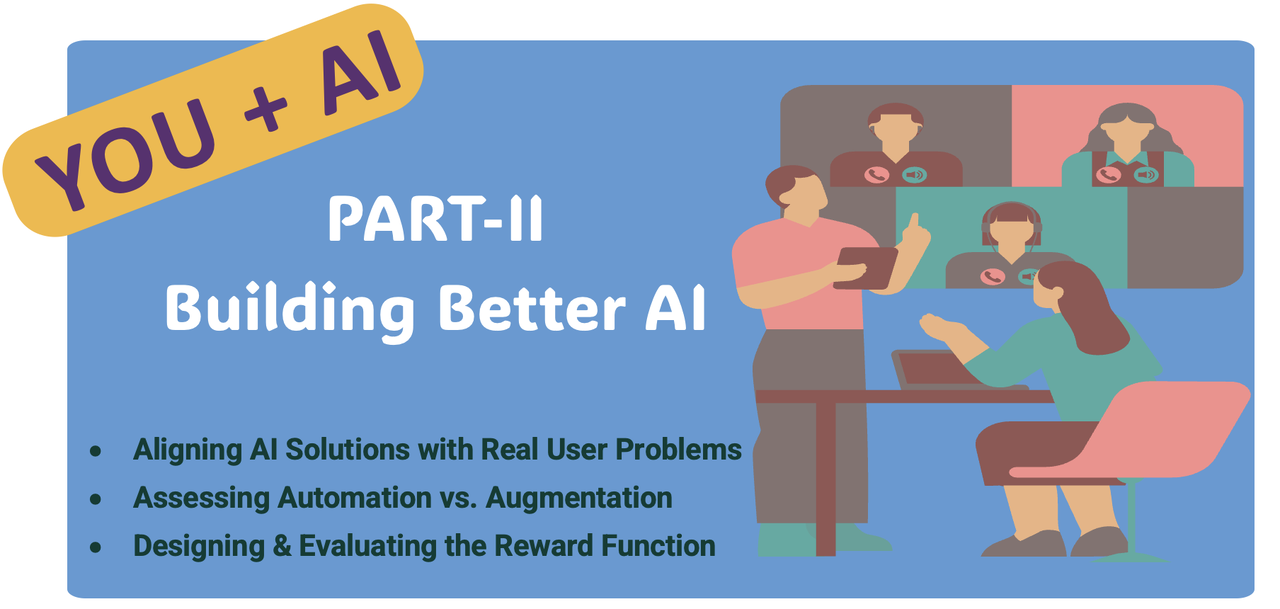
To effectively harness the potential of AI, it is essential to align its strengths with real user needs and define success through thoughtful consideration. Let’s delve into key considerations for identifying suitable user problems, augmenting human capabilities, and optimizing AI’s reward function.
Aligning AI Solutions with Real User Problems
The first crucial step in developing a successful AI product is aligning it with genuine user needs. Finding that sweet spot where user requirements intersect with AI strengths is essential. This not only ensures that the AI product addresses a tangible problem but also that it adds unique value.
Instead of simply asking, “Can we use AI to solve this problem?” start by exploring human-centered solutions with questions like, “How might we solve this problem?” Evaluate whether AI can bring a unique value proposition to the table, offering solutions beyond traditional approaches.
The emphasis here is on employing AI as a solution to real-world problems, all while keeping ethical considerations at the forefront of the development process.
Assessing Automation vs. Augmentation
Once a user problem has been identified, the next crucial decision revolves around whether to automate certain aspects or augment existing processes.
Automate tasks that are challenging, repetitive, or unpleasant, especially when there is a clear consensus on the “correct” way to perform them.
Conversely, augment tasks that people enjoy, that hold social value, or where consensus on the “correct” way to perform them is elusive.
To understand user preferences, ask questions such as, “If you had a human assistant for this task, what duties would you assign them?”
Striking the right balance between automation and augmentation ensures that the AI product complements human capabilities, providing a more seamless and user-friendly experience.
Designing & Evaluating the Reward Function
Every AI model in follows a guide called a “reward function.” It’s like a set of rules written in math that helps the AI decide what’s a good or bad prediction. This guide influences how your system behaves and can greatly impact how users experience it. Think of it as the steering wheel for your AI’s actions.
Establish a clear framework for success and failure within your team. Define specific success metrics and meaningful thresholds.
For instance, “If our specific success metric for the AI-driven feature drops below a meaningful threshold, we will take a specific action.” This ensures a collective understanding of the desired outcomes and a swift response to deviations.
In essence, a well-crafted reward function is the cornerstone of an AI product that not only meets user needs but does so responsibly and ethically.
By navigating these three key aspects – aligning with user problems, assessing automation versus augmentation, and designing a robust reward function – developers can pave the way for AI products that are not just technologically advanced but are also user-centric, responsible, and designed for long-term success.










Leave a Reply