
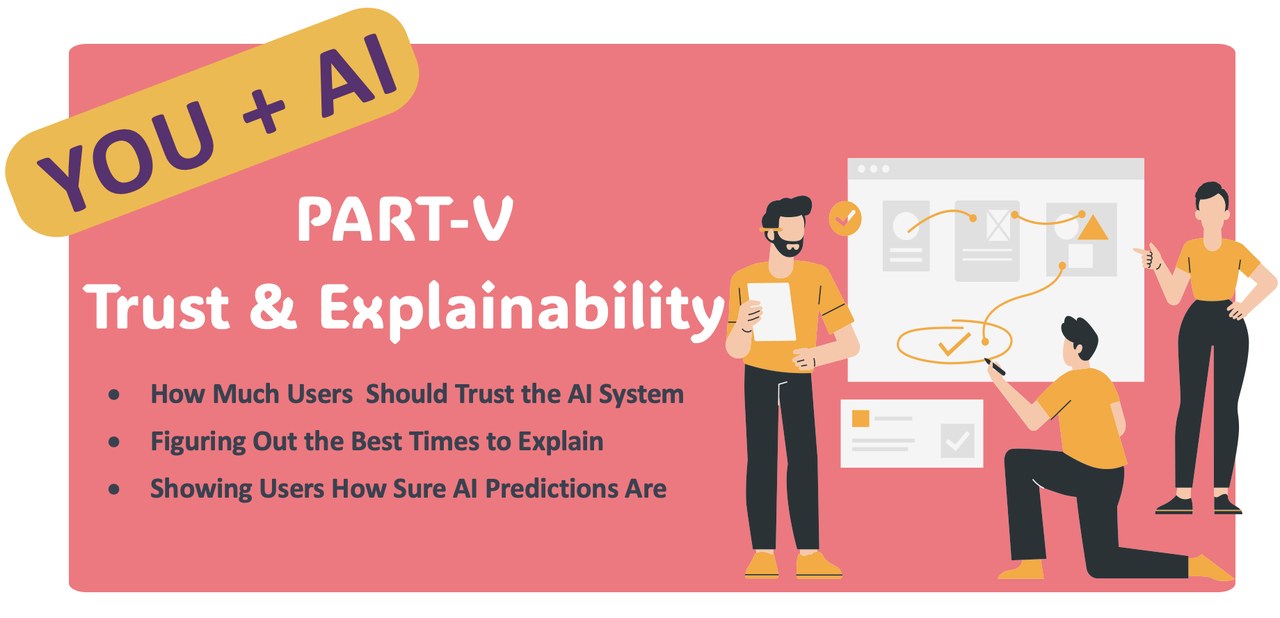
In this fifth part of the series ( here is the last part) , I’ll explore when and how to explain the actions of your AI, the data it relies on for decision-making, and the level of confidence in the results it produces.
AI-powered systems does not produce cent percent accurate results and operate on the basis of probability and uncertainty. For building trust in the produced outcomes, It’s crucial to provide explanations at a level that everyone can understand to help users grasp how these systems function.
When users have a clear understanding of the system’s abilities and limitations, they can decide when to trust it to assist them in achieving their goals and when to use their own judgement.
Here are the Top 4 Considerations for AI based Products
Calibrating User Trust
Assist users in understanding when to trust AI predictions. Since AI relies on statistics, complete trust isn’t advisable. Users should use system explanations to gauge when to rely on the predictions and when to use their own judgment.
For Example: In a health app, if the AI suggests a potential diagnosis, the user should consider the statistical basis for the suggestion rather than blindly relying on it. If the AI has a high confidence level and the user sees a clear explanation, the prediction can be confidently relied upon
As a Best Practice, provide clear explanations and insights alongside predictions to empower users in making informed decisions. Regularly update users on the limitations of the AI system.
Trust Calibration Throughout the Product Experience
Incorporate trust-building across the user journey. Developing the appropriate level of trust is a gradual process. As AI evolves, users’ interactions with the product will also evolve.
For Example: In a virtual assistant, as users interact more and observe the AI adapting to their preferences, they naturally build trust. The system learns and evolves over time, aligning with the user’s changing needs.
As a Best Practice, Implement a gradual onboarding process to introduce users to AI capabilities and updates. Encourage user feedback to enhance the system’s adaptability.
Optimizing for Understanding
Prioritize clarity in communication. Complex algorithms may not always have a straightforward explanation. Developers may not fully understand the intricacies, and even when explainable, it might be challenging to convey in user-friendly terms.
For Example: A recommendation system on a streaming platform might use a complex algorithm. While the developers can’t explain every detail, the system can provide simple insights like “Because you enjoyed X, we suggest Y.”
As a Best Practice, Offer simplified explanations, use visual aids, and employ user testing to ensure that even non-technical users can comprehend the system’s outputs.
Managing Influence on User Decisions
Control the impact on user decisions. Since AI outputs may require user action, determining when and how the system communicates confidence levels is crucial for guiding user decisions and building trust.
For Example: In a financial app, if the AI suggests investment options, displaying a confidence score can help the user assess the reliability of the suggestion before making investment decisions.
As a Best Practice, Clearly communicate confidence levels, and incorporate user feedback to refine the timing and presentation of confidence information. Regularly update users on the system’s performance and reliability metrics.
In conclusion, the successful integration of AI into any system requires a strategic focus on three fundamental aspects.
Firstly, evaluating and fostering user trust in the AI system is paramount for establishing credibility and user confidence.
Secondly, determining the opportune moments for providing explanations ensures that users comprehend the system’s functioning, contributing to a seamless user experience.
Lastly, presenting confidence levels in AI predictions adds a layer of transparency, enabling users to make informed decisions.
By conscientiously addressing these three points, one can pave the way for delivering an exceptional product or professional service that leverages the power of AI effectively.







Leave a Reply