
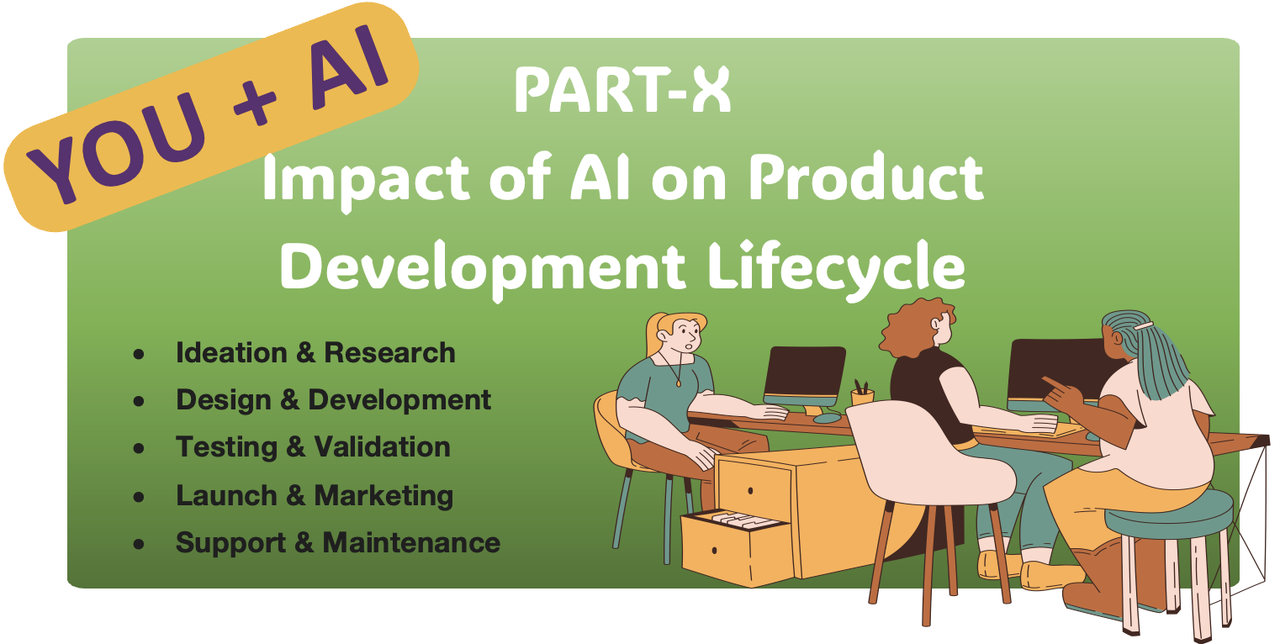
The product development lifecycle (PDLC) is the journey a product takes from conception to launch and beyond. Traditionally, it involved a linear sequence of stages, often burdened by inefficiencies and delays. However, Artificial Intelligence (AI) is emerging as a game-changer, injecting unprecedented efficiency and innovation into each phase of the PDLC.
Stay tuned as the next ten articles will delve into AI tools and frameworks available for each phase of the PDLC, empowering businesses to streamline processes and drive innovation.
How AI impacts each stage
1. Ideation & Research:
- Market and Trend Analysis: AI-powered tools can analyse vast amounts of customer data, social media trends, and competitor information to identify unmet needs and potential opportunities. This can help companies generate more informed and innovative product ideas.
- Concept Testing & User Feedback: AI algorithms can analyse text and feedback from user testing sessions to understand preferences, identify pain points, and refine product concepts quickly and efficiently.
Example: Netflix uses AI to personalize movie recommendations based on user viewing history and trends, leading to higher engagement and satisfaction.
2. Design & Development:
- Product Design & Optimization: AI can generate multiple design variations based on user preferences and data insights, accelerating the iteration process and leading to more user-friendly products.
- Predictive Maintenance & Quality Control: AI-powered systems can analyze sensor data from prototypes and manufacturing processes to predict potential failures and ensure product quality.
Example: Ford uses AI to design car interiors that maximize comfort and minimize driver fatigue, based on simulations and user data.
3. Testing & Validation:
- Automated Testing: AI-powered tools can automate repetitive testing tasks, freeing up human resources for more complex validation processes.
- Personalized Testing & A/B Testing: AI can tailor the testing experience to different user segments based on their characteristics, leading to more relevant and insightful results.
Example: Amazon uses AI to personalize A/B tests of product features for different user groups, optimizing them for specific target audiences.
4. Launch & Marketing:
- Targeted Marketing & Advertising: AI algorithms can analyze customer data and predict buying behavior, enabling personalized marketing campaigns and higher conversion rates.
- Dynamic Pricing & Product recommendations: AI can adjust prices and recommend products based on real-time market trends and individual customer preferences, maximizing revenue and customer satisfaction.
Example: Spotify uses AI to recommend personalized playlists and music based on individual listening habits, increasing user engagement and retention.
5. Support & Maintenance:
- Predictive Customer Support: AI-powered chatbots can answer common customer inquiries and troubleshoot issues, reducing waiting times and improving customer satisfaction.
- Product Usage Analysis & Feedback: AI can analyze user behavior and feedback to identify areas for improvement and proactively address potential issues.
Example: Apple uses AI-powered Siri to answer customer questions and resolve technical issues, improving the overall customer experience.
Beyond Benefits: Addressing Challenges
Benefits of AI in Product Management:
- Faster innovation cycles: Identify and test ideas quickly, leading to earlier market launches.
- Increased efficiency: Automate tasks, freeing up resources for creative problem-solving.
- Data-driven decisions: Leverage insights from vast datasets for informed product decisions.
- Improved user experience: Personalize features and content, resulting in higher satisfaction.
Challenges of AI in Product Management:
- Ethical considerations: Ensure AI models are unbiased and align with ethical principles.
- Data privacy concerns: Address user data privacy concerns and ensure transparency in AI use.
- Technical expertise: Build or acquire the necessary expertise to implement and manage AI tools.
While AI offers undeniable advantages, ethical considerations and potential biases in algorithms need careful attention. Continuous testing, responsible data collection, and human oversight remain crucial to ensure fairness and transparency in AI-powered PDLC tools.
AI is rapidly transforming the PDLC, bringing speed, efficiency, and data-driven insights to every stage. By embracing AI responsibly, companies can develop innovative products that customers love, achieving a competitive edge in the ever-evolving market.
P.S. : Stay tuned as the next ten articles will delve into AI tools and frameworks available for each phase of the PDLC, empowering businesses to streamline processes and drive innovation.






Leave a Reply