
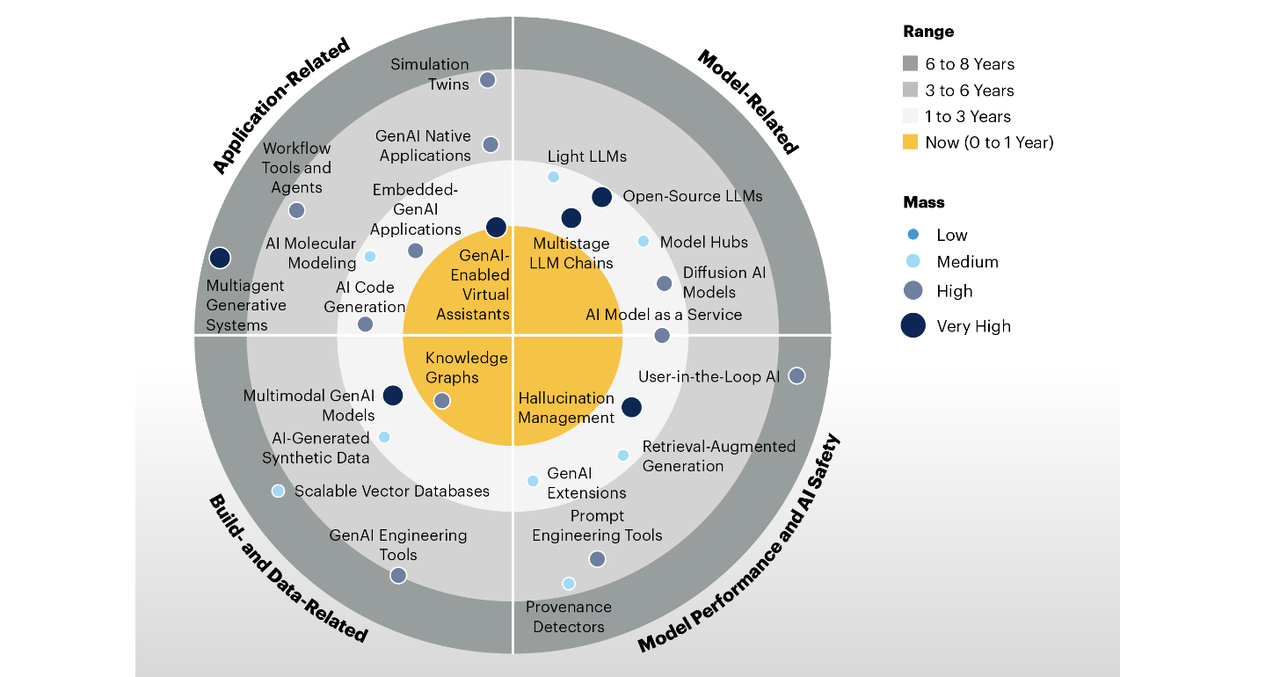
Impact Radar as published by Gartner for the year 2024 has grouped 25 emerging technologies and trends. Here is a snapshot of the report
The radar identifies four key themes: model-related innovations, build and data-related themes, application-related themes, and model performance and AI safety themes.
Each theme is positioned in a matrix according to its relative hype cycle stage (how mature the technology is) and business impact (how much it can affect businesses).
Themes in the upper right quadrant are transformational (high impact, mature), while themes in the lower left quadrant are niche (low impact, immature).
Here is the detailed analysis of the radar as per Gartner
Theme 1: Innovations in Models
This theme constitutes the foundational aspects of GenAI offerings, focusing on various model-related advancements. The technologies and trends within this category include:
- Lightweight Language Models (LLMs)
- Open-source LLMs
- Multistage LLM chains
- Model hubs.
- Diffusion AI models
- AI models as a service (AIMaaS),
By 2027, it is projected that foundation models will underpin 70% of natural language processing (NLP) use cases, a significant increase from less than 5% in 2022.
User Case: These advancements empower developers and businesses to leverage AI capabilities more efficiently, enabling them to cater to specific use cases and scale their AI initiatives effectively.
Industry Insight: The availability of open-source models and AIMaaS reflects a shift towards democratizing AI, making it more accessible to a broader range of businesses and developers.
Theme 2: Model Performance and AI Safety
This theme emphasizes the importance of user involvement in mitigating risks and establishing guidelines for responsible AI deployment. The technologies and trends within this category include:
- User-in-the-loop AI (UITL
- Hallucination management
- Retrieval-augmented generation (RAG.
- GenAI extensions.
- Prompt engineering tools
- Provenance detectors, identifying content generated by AI models.
By 2026, it is anticipated that multimodal AI models will surpass single-modality models in over 60% of GenAI solutions, a substantial increase from less than 1% in 2023.
User Case: These advancements ensure that AI systems are not only efficient but also accountable and reliable, fostering trust among users and stakeholders.
Industry Insight: The emphasis on multimodal models reflects the growing demand for AI systems capable of processing diverse data types, catering to increasingly complex use cases across various industries.
Theme 3: Model Build and Data-Related
This theme encompasses crucial aspects of GenAI model development and data management. The technologies and trends within this category include:
- Knowledge graphs (KGs
- Multimodal GenAI models
- AI-generated synthetic data
- Scalable vector databases
- GenAI engineering tools
User Case: These advancements streamline the development and deployment of AI models, enabling organizations to leverage AI-driven insights more effectively.
Industry Insight: The integration of knowledge graphs and synthetic data generation reflects efforts to enhance AI model training with diverse and representative datasets, ultimately improving model performance and robustness.
Theme 4: AI-Enabled Applications
This theme focuses on emerging applications empowered by AI technologies, catering to both new and existing use cases. The technologies and trends within this category include:
- Simulation twins, combining digital twin technology with AI for predictive simulations.
- GenAI-native applications, designed with GenAI capabilities as their core functionality.
- Workflow tools and agents, facilitating AI-driven interactions with the environment.
- Embedded GenAI applications, enhancing existing software with AI capabilities.
- AI molecular modeling, leveraging simulation for rapid testing of potential treatments.
- Multiagent generative systems (MAGs), simulating complex multi-agent behaviors.
- AI code generation, using LLMs to generate code based on user instructions.
- GenAI-enabled virtual assistants (VAs), offering enhanced functionality through LLMs.
Use the impact radar to inform your strategy for developing GenAI-enabled products and services.
To achieve your business goals, focus on near-term technologies before making long-range GenAI investments to find the right combination of GenAI technologies and trends.
Utilize the impact radar to guide your approach in developing GenAI-enabled products and services. Prioritize near-term technologies to align with your business objectives, reserving long-term investments for GenAI initiatives once the optimal combination of technologies and trends has been identified.



Leave a Reply