Steering AI Led Transformation: Training and Engaging AI Champions

In the introduction article, I mentioned about PMI’s Brightline Transformation Compass that identifies five key building blocks to guide organizations through the complexities of AI-driven change with Train and Engage AI Championsas the  fourth block

For any AI transformation to succeed, it’s crucial that the people within the organization are on board, understand the value of AI, and are motivated to drive this change forward. This is where the concept of AI Champions comes into play.

AI Champions are employees, executives, and leaders who take ownership of AI initiatives and help embed AI into the organization’s day-to-day operations. They bridge the gap between strategy and execution by ensuring that AI projects are aligned with business objectives and that the workforce is prepared to integrate AI into their roles.

The Role of AI Champions in AI-Driven Transformation

Building and implementing an AI transformation program requires a network of volunteer AI champions who will contribute with a sense of ownership and commitment to the results. AI champions come from various levels within the organization—from mid-level managers to frontline employees and senior executives. These champions are crucial in driving AI initiatives, ensuring that AI tools and processes are not only adopted but also effectively utilized to meet organizational goals.

Brightline research highlights that faster-transforming organizations are nearly twice as likely as slower-transforming ones to report a greater focus on developing internal talent. The study also points out that the two most critical ingredients for successful transformation are “sufficient resources” and “existing talent with the right skill set.” Thus, AI Champions are essential in ensuring that the right talent is engaged and developed throughout the transformation process.

Key Steps to Building and Maintaining a Network of AI Champions

  1. Identify: The first step is to identify potential AI champions. Use effective communication strategies and work with the talent department to map out and select the most suitable people to champion the transformation. These individuals should be passionate about AI and its potential impact on the organization. AI Champions should be those who are already motivated to learn and contribute to the AI journey.
  2. Recruit: Recruitment of AI champions revolves around two main pillars: the appeal of the AI transformation vision and the organization’s commitment to supporting the champions throughout the transformation. It’s important to engage employees who are excited about the future of AI and eager to be part of the transformation process. This stage should also involve clear communication of the role and expectations of AI champions.
  3. Motivate: Once recruited, AI champions need to be motivated and empowered. The operating model should offer them opportunities to work on AI projects that matter, providing them with access to senior leaders and allowing them to contribute to strategic decisions. This motivation can be fostered through recognition, incentives, and opportunities for professional growth.
  4. Empower: As AI champions start to take on more responsibilities, it’s important to empower them with the tools, knowledge, and authority they need to succeed. This includes formal and informal mechanisms to place AI champions into positions where they can evangelize the transformation and drive change within their teams. Empowered AI champions will be instrumental in guiding their peers through the AI adoption process and ensuring that AI is effectively integrated into the organization’s operations.

The Role of Project and Program Managers in AI-Driven Transformation

Project and Program Managers (PMs) are critical in the process of training and engaging AI champions. They are responsible for overseeing the entire transformation process, from planning and execution to monitoring and optimization. Here’s how they contribute:

  1. Alignment with Business Objectives: PMs ensure that the training and engagement of AI champions align with the broader business goals. They work closely with AI champions to ensure that their efforts contribute to achieving key objectives, such as improved customer experiences, enhanced content delivery, and increased operational efficiency.
  2. Coordinating Training Programs: PMs organize and coordinate training sessions for AI champions. This includes workshops, seminars, and hands-on training that equip AI champions with the skills they need to succeed. PMs ensure that these training programs are relevant, up-to-date, and tailored to the specific needs of the organization.
  3. Facilitating Cross-functional Collaboration: AI transformation often requires collaboration across different departments, such as IT, marketing, and data science. PMs facilitate this collaboration by bringing together cross-functional teams and ensuring that AI champions work effectively with their colleagues across the organization.
  4. Change Management: PMs play a crucial role in managing the change associated with AI transformation. They help AI champions navigate the cultural and operational shifts that come with AI adoption, ensuring that the transformation process is smooth and that resistance to change is minimized.
  5. Monitoring and Measuring Success: Finally, PMs are responsible for monitoring the progress of AI champions and measuring the impact of their efforts on the organization’s AI initiatives. They use key performance indicators (KPIs) to track the success of AI projects and make adjustments as needed to ensure that the organization is on track to achieve its AI transformation goals.

AI-Driven Transformation in a Sitecore-Based Digital Marketing Agency

Let’s consider the example of a Sitecore-based marketing and digitl transformation  agency that is undergoing AI-driven transformation. Here’s how AI champions can be trained and engaged to drive this transformation:

  1. Identifying AI Champions: The agency identifies potential AI champions from its pool of marketing strategists, content creators, data analysts, and IT professionals. These individuals are passionate about AI and have a deep understanding of the agency’s operations and customer needs.
  2. Recruitment and Motivation: The agency recruits AI champions by highlighting the exciting opportunities that AI offers in terms of innovation and career growth. These champions are motivated by the chance to work on cutting-edge AI projects that will have a significant impact on the agency’s success.
  3. Training and Empowerment: The agency provides AI champions with training in AI technologies, Sitecore CMS, and data analytics. They are also given access to senior leaders and empowered to take on leadership roles within AI projects. This enables them to drive AI initiatives and ensure that the agency’s AI transformation is successful.
  4. Ongoing Support and Collaboration: Throughout the transformation process, AI champions are supported by the Project and Program Managers. They work closely with cross-functional teams to integrate AI into the agency’s operations, from content creation to campaign management.
  5. Monitoring and Optimization: The agency’s PMs monitor the progress of AI champions and use KPIs to measure the success of AI initiatives. Based on these metrics, they make necessary adjustments to optimize AI performance and ensure that the transformation goals are met.

Best Practices for Training and Engaging AI Champions

  1. Clearly Define Roles and Responsibilities: Ensure that AI champions understand their roles and responsibilities within the AI transformation process. This clarity will help them focus on the tasks that are most critical to achieving the organization’s goals.
  2. Provide Continuous Learning Opportunities: AI technologies are constantly evolving, so it’s important to provide AI champions with ongoing learning opportunities. This could include advanced training programs, access to industry conferences, and participation in AI-related forums and communities.
  3. Foster a Collaborative Environment: Encourage collaboration among AI champions and other team members. A collaborative environment will foster the sharing of ideas, knowledge, and best practices, which is essential for the success of AI initiatives.
  4. Recognize and Reward Contributions: Recognize and reward the contributions of AI champions to keep them motivated and engaged. This could include formal recognition programs, promotions, or financial incentives.
  5. Empower AI Champions to Drive Change: Give AI champions the authority and resources they need to drive change within the organization. Empowered champions will be more effective in leading AI initiatives and ensuring that AI is successfully integrated into the organization’s operations.

Training and engaging AI champions is a critical component of AI-driven transformation. By building a network of motivated and empowered champions, organizations can ensure that AI initiatives are successfully implemented and sustained over the long term.

Project and Program Managers play a key role in this process, from coordinating training programs to managing change and monitoring success. In the context of a Sitecore-based companies, AI champions are instrumental in driving innovation, optimizing content delivery, and enhancing customer experiences, ultimately leading to a successful AI transformation.

.

Steering AI Led Transformation: Transformation Operating System

In the introduction article, I mentioned about PMI’s Brightline Transformation Compass that identifies five key building blocks to guide organizations through the complexities of AI-driven change with “AI Driven Transformation Operating System “ as the  third block

I am exploring this block in this article and the role of project and program leadership in the AI transformation

Success with transformation in the digital age is all about how well advanced technologies can be embedded into the core of organizational operations,. The above becomes even more important when considering AI-driven transformations. Therefore, the use of AI to improve customer experiences, optimize content delivery, and drive efficiency in marketing processes is no longer a strategic differentiator but a matter of survival.

After all, technology does not drive change; people do. Thus, how teams are put together and operated will define pace, effectiveness, and success of any such transformation. Hence, from an organizational structures point of view, an AI-driven transformation operating system needs to be put in place. That includes setting up the right organizational structures such as the transformation management office, the AI governance teams, and the cross-functional teams that will help not only drive but also sustain these AI initiatives.

The AI-driven Transformation Operating System

The OS powering AI-driven transformation in the Brightline Transformation Compass focuses on two key teams:

  • Rapid Response Team (RRT): Centrally coordinated, this team includes senior executives in charge of product, talent, R&D, and supply chain. This is the team making fast, strategic decisions to ensure AI initiatives are not only cutting-edge but aligned with wider business goals.
  • Transformation Management Office(TMO) It lays down the governance in place for AI initiatives to ensure that AI projects align with business objectives and that they are delivered effectively. It calls out the key AI opportunities, keeps and manages the portfolio of AI projects, ensuring they feed into the overall transformation goals of the organization.

Such structures are fundamental in embedding AI into the DNA of the organization, ranging from content management and personalization to customer analytics and campaign automation for a Sitecore-based digital marketing agency

Role of Project and Program Managers

Project and Program Managers have the most significant role in implementing AI-driven transformation successfully . Their role goes beyond mere project management into the following:

  • Alignment of AI Initiatives with Business Objectives: Project and program managers align AI initiatives with business outcomes, such as creating more engaging customers, increasing conversion rates, or efficient content delivery through a content management system in Sitecore.
  • Coordination Across Cross-functional Teams: Transforms with AI require collaboration between data scientists, marketers, IT professionals, and content creators. The Project and Program Managers make sure that the teams are in sync for the same objective.
  • Managing AI Project Lifecycles: Right from ideation to implementation, Project and Program Managers govern the entire lifecycle of AI projects. This would relate to scoping the project, managing resources, monitoring progress, and mitigating risks.
  • Change Management: The introduction of AI  could mean radically different ways of performing work. Therefore, managing such change, training of teams, and smooth integration of AI tools within workflows rest on the shoulders of the Project and Program Managers.
  • Stakeholder Communication: Communication with regularity is very much essential to keep stakeholders updated regarding the progress of AI initiatives, manage expectations, and elicit buy-in.

AI-driven Transformation in a Sitecore-based Digital Marketing  Agency

Let’s take the case of a Sitecore-based digital marketing agency to implement AI-driven transformation.

Scenario

The requirement of the agency is to incorporate AI into its content personalization engine, enhance customer segmentation, and manage campaigns on automated lines.

Key Steps:

  • Forming RRT and TMO: The RRT will be constituted with the agency, comprising CDO, Practice Head, Technical Architects , Delivery leaders trained on AI, among others; constitute TMO to oversee all the projects on AI regarding the fulfilment of business objectives at large and maintaining the portfolio of AI initiatives.
  • Pilot AI Projects: The agency identifies pilot projects involving AI-driven content personalization and automated customer segmentation or AI bots for personalized chat support. Each pilot is assigned a dedicated Project Manager who will work in close collaboration with TMO. This can
  • Cross-functional Collaboration: The Project Manager shall facilitate the collaboration between the AI team and the Sitecore development team for integrating the AI tools with the Sitecore CMS capable of real-time content personalization.
  • Training and Change Management: The Program Manager oversees a training program to make sure all members are comfortable using the new AI tools and enhanced workflows.
  • Monitoring and Optimization: The Project Manager sets up KPIs by which to monitor the personalization engine and segmentation algorithms for effectiveness. Based on the outcome, continuous optimization is made in the AI models by the agency.

Scaling AI Initiatives: After successful pilots, TMO approves the scaling of AI initiatives across other areas of the agency including campaign automation and customer analytics.

Best Practices for AI-driven Transformation

  • Set Well-defined and Measurable Objectives: Clearly define objectives of AI initiatives with a line to the general business objectives of the agency. This shall ensure that AI projects deliver tangible value.
  • Encourage Collaboration Across Functions: Encourage collaboration among experts in AI, marketers, content developers, and IT to make sure the solutions are properly integrated and utilized effectively.
  • Invest in Change Management: Get your teams ready for what AI is going to bring along with proper training and support so that it softens resistance to a smooth transition.
  • Monitor and Iterate: KPIs will let you track the performance of AI initiatives. Be ready to iterate based on your results. Continuous improvement is critical to having AI realize full impact.
  • Governance and Oversight: Finally, create a TMO to oversee AI initiatives. In this way, you are able to make sure that they support business objectives while managing risks effectively.

Project and Program Managers will be at the very core of this transformation-securing that AI initiatives are relevant in terms of business goals and effectively implemented and scaled into the organization. Organizations can thus embed AI into the organization’s fabric by continuing investment in cross-functional collaboration and change management, thereby driving innovation with great customer experiences.

Steering AI-Led Transformation: Customer and Market Insights

In the introduction article, I mentioned about PMI’s Brightline Transformation Compass that identifies five key building blocks to guide organizations through the complexities of AI-driven change with “Leverage Customer and Market Insights “ as the  second block

In this article, I’ll explore the importance  of leveraging Customer and Market Insights for AI-driven transformation, using a digital marketing agency as an example. This agency leverages Sitecore CMS (Content Management System) to elevate its digital transformation, integrating AI to deliver more personalized and effective marketing campaigns for its customers.

Leveraging customer and market insights is not just an advantage; it is a necessity for organizations undergoing AI Led  transformation. The Brightline Transformation Compass highlights the significance of understanding customer needs, behaviors, and market competition to drive strategic decisions. A strong understanding of these dynamics is crucial for successful AI adoption and the modernization of business practices.

For project and program managers, particularly in the context of transformation within a   digital marketing firm, this phase offers both challenges and opportunities. Managers need to ensure that customer and market insights are woven into every aspect of the transformation journey. This article outlines the key actions for leveraging these insights, emphasizing the critical role that project and program managers play in AI-driven digital transformation.

The Transformation Journey: Understanding Customer and Market Insights

As AI moves from research laboratories into practical business applications, the number of AI success stories continues to grow. According to industry data, AI adoption has been accelerating, with notable advancements emerging from corporate-driven initiatives rather than purely academic endeavors. However, effectively deploying AI requires businesses to focus on customer and market insights — understanding what customers expect, what their unmet needs are, and how competitors are adapting to these shifts.

For a Sitecore-based digital marketing firm undergoing AI transformation, these insights should be a compass guiding every decision. Project and program managers must facilitate this transformation by fostering a deep understanding of the market landscape, customer behaviour, and industry benchmarks.

Role of Project and Program Managers

Project and program managers in a digital marketing firm play a pivotal role in orchestrating this AI-based transformation. They are responsible for ensuring that AI-driven strategies align with customer expectations and market trends while minimizing risks and maximizing efficiency.

Here are the key steps project and program managers must take:

1. Mapping the Market and Competitive Landscape

Project and program managers need to drive efforts to collect, analyze, and act upon market and competitive insights. By leveraging tools such as AI-powered analytics and predictive models, managers can develop a clear map of the market. This includes identifying industry leaders, emerging trends, and customer behaviors that are being shaped by AI.

For a Sitecore-based firm, for example, project managers should prioritize analyzing how competitors are using AI to personalize digital experiences. Sitecore, known for its customer experience management and digital marketing capabilities, can benefit from AI-powered personalization and customer data analytics. Understanding what competitors are doing with similar platforms helps shape the strategy for AI integration.

2. Understanding Customer Expectations and Behaviors

In digital marketing, the customer is at the center of every decision. Therefore, program managers must lead efforts to gather and analyze customer data. Using AI-based tools, they can gain a deeper understanding of customer expectations, identify unmet needs, and foresee shifts in behavior.

For instance, AI-driven customer insights may reveal that customers expect more personalized content and seamless digital experiences across various channels. To meet this expectation, the project manager can ensure that AI models are integrated into Sitecore to enhance personalization, optimize user journeys, and deliver targeted content based on behavioral data.

3. Efficiently Addressing Customer Needs with AI

Once customer insights are gathered, project managers need to ensure that AI solutions are implemented efficiently to address customer needs. This may involve deploying AI tools for predictive analytics, chatbots for customer support, or personalized marketing campaigns that adapt in real time to customer behavior.

Program managers must also ensure that AI solutions are scalable and cost-effective. For example, in a Sitecore environment, AI can automate content delivery and marketing workflows, reducing operational costs while enhancing customer engagement. Managers must work closely with technical teams to ensure AI systems are effectively integrated into the company’s existing digital infrastructure.

4. Ensuring Alignment Across Teams

As AI reshapes business processes, project and program managers must ensure alignment across various teams — from marketing to IT and customer service. The success of AI implementation depends on the collaboration between teams to deliver a unified, data-driven customer experience.

For a Sitecore-based firm, this might involve training teams on how to leverage AI tools within Sitecore to automate tasks like content management, campaign delivery, and customer segmentation. Program managers can facilitate workshops and training sessions to ensure that employees are well-equipped to make the most of AI-powered features.

5. Measuring and Adapting AI Success

AI adoption is an ongoing process, and project managers must continuously measure the success of AI initiatives. This includes setting KPIs, tracking performance, and adjusting strategies based on real-time insights.

In the context of a Sitecore-based marketing firm, managers should monitor metrics such as engagement rates, customer satisfaction scores, and conversion rates. If AI-driven personalization is not yielding the desired outcomes, project managers must work with their teams to tweak algorithms and optimize performance.

AI-powered solutions offer digital marketing firms the opportunity to not only meet customer expectations but to exceed them by delivering personalized, data-driven experiences at scale. With thoughtful leadership from project and program managers, these transformations can lead to more agile, competitive, and customer-centric organizations.

Steering AI-Led Transformation: Defining the North Star

In the introduction article, I mentioned about PMI’s Brightline Transformation Compass that identifies five key building blocks to guide organizations through the complexities of AI-driven change with Defining a “North Star” Vision as the first block

Defining a “North Star” dictates establishing a clear, a guiding vision that aligns an organization’s goals, strategies, and execution plans. Embarking on an AI-driven transformation journey without a clear vision can lead to scattered efforts and missed opportunities.

In this article, I’ll explore the importance of establishing a North Star for AI-driven transformation, using a digital marketing agency as an example. This agency leverages Sitecore CMS (Content Management System) to elevate its digital transformation, integrating AI to deliver more personalized and effective marketing campaigns for its customers.

The North Star : What It Is and Why It Matters

A North Star is a clear, overarching goal that aligns every aspect of an organization’s transformation journey. It serves as a beacon, guiding decision-making, resource allocation, and strategy execution. In the context of AI-driven transformation, a North Star vision ensures that all AI initiatives contribute to a cohesive, long-term objective, rather than being isolated projects with limited impact.

For a digital marketing agency, the North Star might revolve around enhancing customer engagement through personalized content delivery, improving campaign effectiveness, and optimizing ROI for clients. This vision not only sets the direction for AI adoption but also helps the agency stay focused on delivering value to its customers.

Example: Digital Marketing Agency’s AI-Driven Transformation with Sitecore CMS

Let’s consider a digital marketing agency that has been serving clients with traditional content strategies but now wants to harness the power of AI to stay competitive. The agency uses Sitecore CMS, a powerful platform known for its capabilities in managing and delivering personalized content.

1. Defining the North Star Vision

The agency’s North Star vision could be: “To become the leading digital marketing agency that delivers hyper-personalized, data-driven content to clients, enhancing customer engagement and maximizing ROI through AI-powered insights.”

This vision focuses on leveraging AI to create a more personalized experience for clients’ customers, using data to drive content strategies and optimize campaign performance.

2. Aligning AI Initiatives with the North Star

With a clear North Star in place, the agency can now align its AI initiatives to support this vision. Here’s how this might look:

  • Personalization at Scale: By integrating AI with Sitecore CMS, the agency can analyse customer behaviour and preferences in real time. This allows for the creation of highly personalized content that resonates with individual users, leading to increased engagement and conversion rates. While AI capabilities are restricted(This is based on my current understanding of the CMS and is not intended to diminish or undervalue Sitecore in any way), the agency should focus on hiring AI talent develop inhouse tools/connectors to enhance personalization capabilities provided by Sitecore
  • Predictive Analytics for Campaign Optimization: The agency can use AI to analyze historical campaign data and predict which strategies are most likely to succeed. This insight helps in refining campaigns before they go live, ensuring better outcomes for clients.
  • Automated Content Creation: AI-driven tools can assist in generating content that aligns with the client’s brand voice while being tailored to specific audience segments. This not only speeds up the content creation process but also ensures consistency and relevance. Automated content creation should have an additional proof reading layer by Sitecore content pop specialist to detect and filter biased content (Ethical guidelines  for Gen AI  created content should be clearly laid out and resources trained to detect unethical content). I wrote a detailed article on Ethics and Biases in my YOU+AI series, which can serve as good starting point
  • Enhanced Customer Insights: By harnessing AI, the agency can gain deeper insights into customer journeys, identifying pain points and opportunities for engagement. This data-driven approach enables the agency to refine its strategies continuously, delivering better results over time.

3. The Role of Program Leaders

Program leaders play a crucial role in translating the North Star vision into actionable steps. In this case, they would be responsible for:

  • Ensuring Alignment: Making sure that all AI initiatives, from content personalization to predictive analytics, align with the North Star vision.
  • Facilitating Collaboration: Working across departments—such as IT, content creation, and client services—to integrate AI smoothly into existing workflows. I wrote an article sometime ago on Embracing AI at work that has guidelines and frameworks to align workforce in this AI era
  • Monitoring Progress: Regularly reviewing the impact of AI initiatives on client satisfaction and campaign performance, adjusting strategies as needed to stay aligned with the vision.

4. Measuring Success

Success in this transformation journey isn’t just about implementing AI technologies; it’s about achieving the outcomes defined by the North Star vision. For the digital marketing agency, this means:

  • Improved Customer Engagement: Tracking metrics such as time spent on site, content interactions, and conversion rates to ensure that AI-driven personalization is delivering results.
  • Higher ROI for Clients: Demonstrating tangible improvements in campaign performance and customer acquisition, reinforcing the agency’s value proposition to its clients.
  • Scalability and Efficiency: Assessing how AI has streamlined operations, from content creation to campaign execution, and whether the agency can scale its services without compromising quality.

Defining a North Star vision is a critical first step in any AI-driven transformation journey. For a digital marketing agencies, this vision not only guides the adoption of AI technologies but also ensures that every initiative contributes to a cohesive, long-term goal. By aligning AI efforts with a clear North Star, the agency can deliver more personalized, data-driven content, optimize client campaigns, and ultimately, achieve sustained success in a competitive digital landscape.

As you embark on your own AI-driven transformation, remember that a clear vision is your most valuable asset. It keeps your organization focused, motivated, and aligned, ensuring that your journey leads to meaningful and lasting change

Steering AI-Led Transformation: A Guide for Program Leaders: Introduction

AI has rapidly become a focal point for enterprises across industries, with organizations racing to develop cutting-edge models and frameworks that enhance productivity and offer new capabilities. But, as recent research suggests, technology alone is not enough to guarantee a successful transformation. PMI’s recent report, Leading AI-driven Business Transformation: Are You In, introduces a critical tool—the Brightline Transformation Compass—designed to help organizations ensure their AI-led initiatives achieve the desired impact.

In this introductory article, the first in a five-part series, I will explore key insights from the report and highlight essential considerations for business leaders and program managers embarking on AI-driven transformation journeys.

The Brightline Transformation Compass: A Holistic Approach

Article content

While much of the conversation around AI-driven transformation focuses on technology—how to build more sophisticated AI systems—PMI’s Brightline Transformation Compass emphasizes a balanced approach that places people at the center of the transformation process. In essence, AI is only as powerful as the people who harness it. A successful transformation requires more than just advanced technology; it needs to cultivate an environment where employees understand, adopt, and maximize the benefits AI offers.

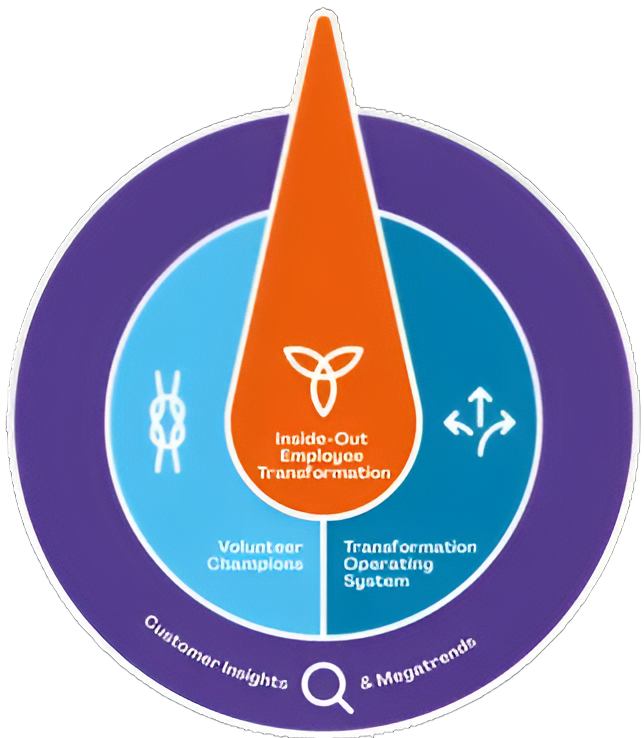
The Compass identifies five key building blocks to guide organizations through the complexities of AI-driven change:

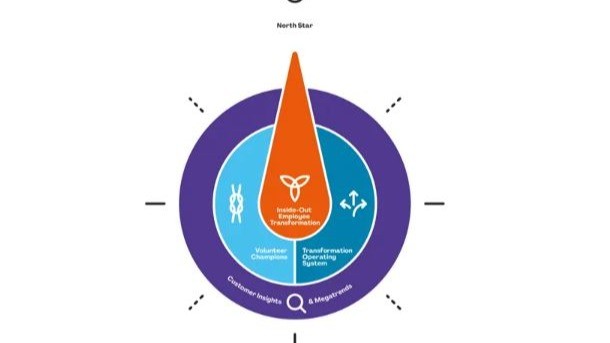
  • North Star – A term referring to a crisp, inspiring articulation of the vision and strategic objectives for the transformation. For the AI transformation program, it covers the vision — the “why” — that is the foundation of the transformation.
  • Customer and market insights and megatrends – These offer a deep understanding of the market and customer and the megatrends affecting them. It also covers what competition is doing in terms of AI adoption.
  • The transformation operating system – This is how the organization will put together the team structure and resources to support the AI transformation initiative execution.
  • AI transformation champions – How the organization will engage, integrate and motivate everyone to contribute to and drive the transformation.
  • Inside-out employee transformation – This building block focuses on talent development and growth to connect employee aspirations to the transformation’s strategic goals and vision

The Role of Project and Program Leaders

In today’s evolving landscape, project and program leaders hold the responsibility to bridge the gap between AI technologies and the people who will use them. These leaders are tasked with driving adoption and ensuring teams are equipped to navigate the new ways of working brought about by AI. Without strong leadership, even the most advanced AI tools can fail to deliver sustainable, long-term benefits.

Key challenges often encountered during AI-led transformations include employee resistance, lack of clarity in goals, and slow benefits realization. Project leaders must focus on aligning the goals of AI initiatives with the aspirations of employees, ensuring that transformation efforts remain people-centric and deliver value across the organization.

Overcoming Common Transformation Pitfalls

AI transformation, despite its promise, comes with risks. As PMI’s report outlines, organizations face numerous challenges, such as employee disengagement, turnover, unclear purposes, and cost overruns. The Brightline Transformation Compass offers a guiding framework to mitigate these risks. By addressing each of the five critical building blocks in a coordinated manner, businesses can create a sustainable transformation path that avoids common pitfalls.

What’s Next?

Through the next four articles, I will dive deeper into each of the key success factors outlined in the Brightline Transformation Compass. Together, we will explore the challenges and opportunities AI presents, offering actionable insights for business leaders aiming to lead effective AI-driven transformations.

Stay tuned for the next article, where I will discuss how to define a compelling “North Star” vision and align execution plans to ensure success in AI transformation initiatives

Leveraging AI to Solve Top 10 MarTech Use Cases

Artificial Intelligence (AI) is revolutionizing the marketing technology (Martech) landscape, providing tools that help businesses automate processes, enhance customer engagement, and stay ahead of the competition.

In this article, I delve into the top 10 Martech use cases where AI will have a significant impact. Each use case insight is validated by Market research reference and reports from top industry leaders

1. Personalized Customer Experiences

Why: Today’s consumers demand personalized interactions. According to Salesforce, 76% of consumers expect companies to understand their needs and expectations. AI’s ability to analyze vast amounts of customer data allows businesses to deliver highly tailored experiences across multiple channels.

How: AI-driven algorithms can segment customers based on behavior, preferences, and demographics. For instance, Netflix’s recommendation engine uses AI to suggest content based on individual viewing habits, significantly improving user satisfaction and engagement.

Market Research Reference: Salesforce State of the Connected Customer Report

2. Predictive Analytics for Campaign Optimization

Why: Predictive analytics is a game-changer for marketers, enabling them to anticipate customer behavior and optimize campaigns for maximum effectiveness. AI processes vast datasets to predict trends and outcomes, boosting campaign performance.

How: By analyzing historical data, AI can identify which customers are most likely to convert and recommend the best times to launch campaigns. Starbucks, for example, uses AI to predict the success of its promotions by analyzing customer purchasing patterns, which has led to increased sales and customer loyalty.

Market Research Reference: Gartner’s Magic Quadrant for Marketing Analytics

3. Chatbots and Conversational AI for Customer Support

Why: AI-powered chatbots are now integral to customer support, providing instant, 24/7 assistance that enhances customer satisfaction. Recent projections show that chatbots could save businesses up to $11 billion annually by 2024.

How: AI chatbots use natural language processing (NLP) and machine learning (ML) to understand and respond to customer queries. Sephora’s chatbot, for example, offers personalized makeup advice, driving engagement and boosting sales.

Market Research References:

4. Content Generation and Curation

Why: Content creation is a time-intensive task, but AI can automate much of it, helping marketers produce high-quality, relevant content quickly.

How: AI tools like GPT-4 can generate blog posts, social media content, and even video scripts with minimal input. The Washington Post’s AI tool, Heliograf, writes news articles on topics ranging from sports to finance, allowing the newspaper to cover more stories efficiently.

Market Research Reference: Forrester’s AI in Content Creation Report

5. Social Media Management and Analysis

Why: Managing social media accounts and analyzing their data can be overwhelming. AI streamlines these tasks by automating content posting and providing insights into performance.

How: AI tools can schedule posts, analyze engagement, and predict the best times to post. Coca-Cola uses AI to analyze social media sentiment, helping the brand stay connected with its audience and respond quickly to trends.

Market Research Reference: Hootsuite Social Media Trends Report

6. Customer Segmentation and Targeting

Why: Effective marketing hinges on understanding your audience. AI excels at analyzing customer data to create precise segments, enabling targeted marketing.

How: AI algorithms can process extensive datasets to identify patterns and segment customers based on factors like purchase history and demographics. Amazon uses AI for segmentation, tailoring recommendations that drive conversions and customer satisfaction.

Market Research Reference: McKinsey’s Next in Personalization Report

7. Email Marketing Optimization

Why: Email marketing remains a highly effective channel, but AI can supercharge its effectiveness by optimizing every aspect of the process.

How: AI personalizes subject lines, optimizes send times, and tailors content to individual recipients. Phrasee, an AI copywriting tool, has helped brands like eBay increase email open rates by crafting more compelling subject lines.

Market Research Reference: Campaign Monitor’s Ultimate Email Marketing Benchmarks Report –

8. Programmatic Advertising

Why: Programmatic advertising automates digital ad buying, but AI enhances it by making real-time bidding decisions based on data insights.

How: AI algorithms decide which ads to show, to whom, and when, based on user data. Procter & Gamble (P&G) uses AI in programmatic advertising to reach its target audience more effectively, resulting in more efficient ad spend and higher engagement.

Market Research Reference: eMarketer’s Programmatic Advertising Outlook

9. Voice Search Optimization

Why: As voice-activated assistants become more popular, optimizing content for voice search is vital. AI helps by understanding spoken language nuances and user intent.

How: AI analyzes voice search data to understand common queries and optimize content accordingly. Domino’s Pizza uses voice search optimization to streamline orders through smart speakers, enhancing customer convenience and boosting sales.

Market Research Reference: Comscore’s Voice Search Trends Report

10. Customer Journey Mapping

Why: Mapping the customer journey is essential for delivering a seamless experience. AI can map this journey by analyzing interactions across multiple touchpoints.

How: AI tracks customer interactions in real-time, providing insights into their movement through the sales funnel. Disney uses AI to map customer journeys across its theme parks, optimizing the experience by predicting and reducing wait times.

Market Research Reference: Gartner’s Customer Journey Mapping Guide

AI is no longer just a futuristic concept; it’s a critical tool for solving Martech’s biggest challenges. By automating processes, personalizing interactions, and providing data-driven insights, AI empowers Martech companies to enhance their strategies and deliver exceptional customer experiences. The future of Martech lies in harnessing the full potential of AI, and the insights and tools discussed here are just the beginning.

Scaling Gen AI: Insights, Techniques, and Best Practices for Handling Unstructured Data

The advent of generative AI (gen AI) offers a transformative opportunity for organizations to leverage advanced data analytics and automation. This shift necessitates robust data platforms and a strategic approach to managing both structured and unstructured data. To successfully integrate gen AI capabilities, organizations must focus on data quality, efficient data management, and strong security protocols.

McKinsey recently published a report titled “A data leader’s technical guide to scaling gen AI”.

Key Insights from the McKinsey’s Guide

Enhancing Data Quality:

  • Accuracy and Relevance: High-quality data is critical to avoid inaccurate AI outputs, costly corrections, and potential security risks.
  • Managing Unstructured Data: Tools like knowledge graphs and multimodal models can help manage complex data relationships and formats.

Creating and Managing Data Products:

  • End-to-End Data Product Creation: Automation in creating data pipelines and products can significantly reduce time and increase scalability.
  • Synthetic Data Generation: Generative AI tools can create synthetic data for testing and development, especially in highly regulated industries like healthcare.

Improving Data Management:

  • Orchestration and Modularity: Utilizing agent-based frameworks ensures consistency and reusability in managing gen AI applications.
  • Data Catalogs and Metadata Tagging: Gen AI-augmented data catalogs can enhance real-time metadata tagging and data discovery.

Security and Coding Standards:

  • Data Security: Implementing modularized pipelines with robust security controls is essential for handling unstructured data.
  • Integrating Coding Best Practices: Ensuring that gen AI-generated code adheres to organizational standards helps maintain quality and consistency.

Techniques for Integrating Gen AI

Enhanced Data Pipelines:

  • Medallion Architecture: A medallion architecture helps organize data and supports modular pipeline development, aiding in the integration of gen AI capabilities. Read more about MedallionArchitecture Read more about data modelling design patterns(technical experience required to grasp the concepts)
  • Automated Evaluation Methods: Automated methods to evaluate and score data relevancy can enhance the accuracy of AI outputs.

Utilizing Synthetic Data:

  • Test Data Generation: Synthetic data can be used to test and validate new functionalities, safeguarding real data.

End-to-End Automation:

Data Orchestration:

Best Practices for Handling Unstructured Data

Modular Data Security:

Role-Based Access Control: Implementing role-based access controls at each checkpoint in the data pipeline ensures secure handling of unstructured data.

Data Cataloging and Metadata Management:

Automated Metadata Generation: Gen AI can automatically generate metadata from unstructured content, improving data management and discovery.

Coding Standards Integration:

Quality Assurance: Reviewing and integrating gen AI-generated code with existing coding standards is crucial for maintaining data quality and consistency.

Continuous Monitoring and Evaluation:

Regular Audits: Conducting regular audits of data pipelines and gen AI outputs helps identify and address issues promptly.

Integrating generative AI into organizational systems presents both challenges and opportunities. By focusing on data quality, employing advanced data management techniques, and ensuring robust security measures, organizations can fully realize the potential of gen AI.

Death by Excel: Burying Your Projects in Spreadsheets

You might be familiar with the term “Death by PowerPoint,” where data is presented in lengthy, unproductive meetings with no actionable outcomes.

Similarly, “Death by Excel” describes a scenario where you dive into using Excel for project management without fully considering your project’s needs. This often results in excessive manual updates and heavy, data-intensive workbooks that require significant resources just to manage the data.

Microsoft Excel has been an indispensable tool since its launch in 1985. Its robust feature set includes data analysis, graphing, and a wide range of formulas that cater to various business needs. Excel’s adaptability has made it a favourite for project management, allowing users to create detailed project plans, track progress, and manage resources all in one place.

Some Critical features making Excel indispensable

  1. Flexibility: Excel can be customized for virtually any project management task.
  2. Familiarity: Most professionals are trained in its use, reducing the learning curve.
  3. Integration: Seamlessly integrates with other Microsoft Office products.

However, I have observed many professionals jumping to Excel sheets without considering whether Excel aligns with their project data, workflows, tracking and reporting needs.

Consider a Program Management Scenario:

  1. Five cross-functional teams.
  2. Each team has sequential activities flowing through the work pipeline.
  3. Each step produces multiple outputs (files, documents, data).
  4. Teams need notifications once the previous team completes their activities.
  5. Five main project statuses, each with 2-3 sub-statuses that need tracking.
  6. Over 20 projects are delivered weekly.

It was surprising to see Excel even being considered for tracking this. I preferred and implemented JIRA as a solution for the following reasons:

  1. Task Management: Easy task creation( even from Outlook mails), assignment, and tracking.
  2. Project Views: Offers multiple project views (list, board, timeline) to suit different  team and management level project health and status reporting
  3. Collaboration: Enhanced collaboration features, including comments, file attachments, and team messaging.
  4. Work Queues : I automated task assignment to individual team queues and inter-team work flow based on the status and substates of the tasks
  5. Automation: Automates repetitive tasks, freeing up time for more critical work.
  6. Reporting and Analytics: JIRA provides insightful reports and dashboards that visualize project progress, identify bottlenecks, and measure team performance.
  7. Integrations: JIRA integrates with wide variety of tools including Realtime export to Excel using JQL or pre-defined Filters, streamlining workflows and centralizing project information

Using JIRA, I am able to track 50+ projects in a daily stand-up meeting within 30 minutes.

What are Your Thoughts?

If you had to implement and manage this kind of program, what tool would you choose among the plethora of project, task, and workflow management tools available? Share your experiences and recommendations!

Gartner -Impact Radar for Gen AI-2024

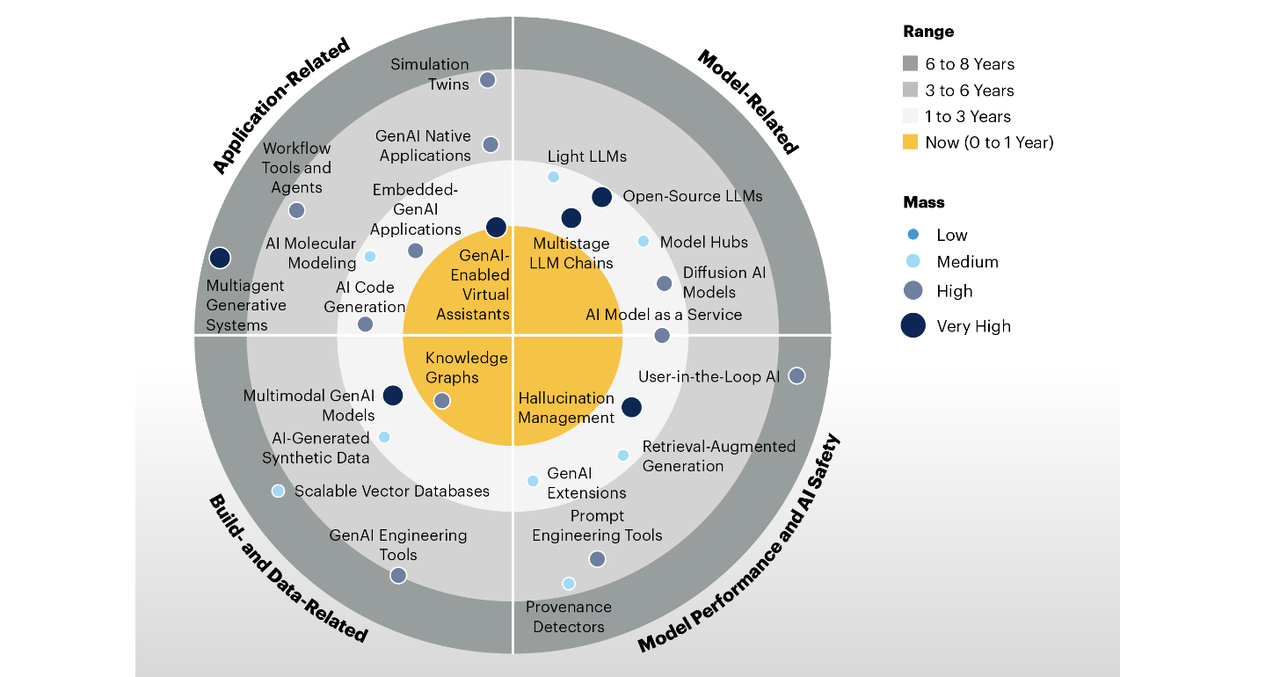
Impact Radar as published by Gartner for the year 2024 has grouped 25  emerging technologies and trends. Here is a snapshot of the report

The radar identifies four key themes: model-related innovations, build and data-related themes, application-related themes, and model performance and AI safety themes.

Each theme is positioned in a matrix according to its relative hype cycle stage (how mature the technology is) and business impact (how much it can affect businesses).

Themes in the upper right quadrant are transformational (high impact, mature), while themes in the lower left quadrant are niche (low impact, immature).

Here is the detailed analysis of the radar as per Gartner

Theme 1: Innovations in Models

This theme constitutes the foundational aspects of GenAI offerings, focusing on various model-related advancements. The technologies and trends within this category include:

  • Lightweight Language Models (LLMs)
  • Open-source LLMs
  • Multistage LLM chains
  • Model hubs.
  • Diffusion AI models
  • AI models as a service (AIMaaS),

By 2027, it is projected that foundation models will underpin 70% of natural language processing (NLP) use cases, a significant increase from less than 5% in 2022.

User Case: These advancements empower developers and businesses to leverage AI capabilities more efficiently, enabling them to cater to specific use cases and scale their AI initiatives effectively.

Industry Insight: The availability of open-source models and AIMaaS reflects a shift towards democratizing AI, making it more accessible to a broader range of businesses and developers.

Theme 2: Model Performance and AI Safety

This theme emphasizes the importance of user involvement in mitigating risks and establishing guidelines for responsible AI deployment. The technologies and trends within this category include:

  • User-in-the-loop AI (UITL
  • Hallucination management
  • Retrieval-augmented generation (RAG.
  • GenAI extensions.
  • Prompt engineering tools
  • Provenance detectors, identifying content generated by AI models.

By 2026, it is anticipated that multimodal AI models will surpass single-modality models in over 60% of GenAI solutions, a substantial increase from less than 1% in 2023.

User Case: These advancements ensure that AI systems are not only efficient but also accountable and reliable, fostering trust among users and stakeholders.

Industry Insight: The emphasis on multimodal models reflects the growing demand for AI systems capable of processing diverse data types, catering to increasingly complex use cases across various industries.

Theme 3: Model Build and Data-Related

This theme encompasses crucial aspects of GenAI model development and data management. The technologies and trends within this category include:

  • Knowledge graphs (KGs
  • Multimodal GenAI models
  • AI-generated synthetic data
  • Scalable vector databases
  • GenAI engineering tools

User Case: These advancements streamline the development and deployment of AI models, enabling organizations to leverage AI-driven insights more effectively.

Industry Insight: The integration of knowledge graphs and synthetic data generation reflects efforts to enhance AI model training with diverse and representative datasets, ultimately improving model performance and robustness.

Theme 4: AI-Enabled Applications

This theme focuses on emerging applications empowered by AI technologies, catering to both new and existing use cases. The technologies and trends within this category include:

  • Simulation twins, combining digital twin technology with AI for predictive simulations.
  • GenAI-native applications, designed with GenAI capabilities as their core functionality.
  • Workflow tools and agents, facilitating AI-driven interactions with the environment.
  • Embedded GenAI applications, enhancing existing software with AI capabilities.
  • AI molecular modeling, leveraging simulation for rapid testing of potential treatments.
  • Multiagent generative systems (MAGs), simulating complex multi-agent behaviors.
  • AI code generation, using LLMs to generate code based on user instructions.
  • GenAI-enabled virtual assistants (VAs), offering enhanced functionality through LLMs.

Use the impact radar to inform your strategy for developing GenAI-enabled products and services.

To achieve your business goals, focus on near-term technologies before making long-range GenAI investments to find the right combination of GenAI technologies and trends.

Utilize the impact radar to guide your approach in developing GenAI-enabled products and services. Prioritize near-term technologies to align with your business objectives, reserving long-term investments for GenAI initiatives once the optimal combination of technologies and trends has been identified.

AI is Transforming Project Management

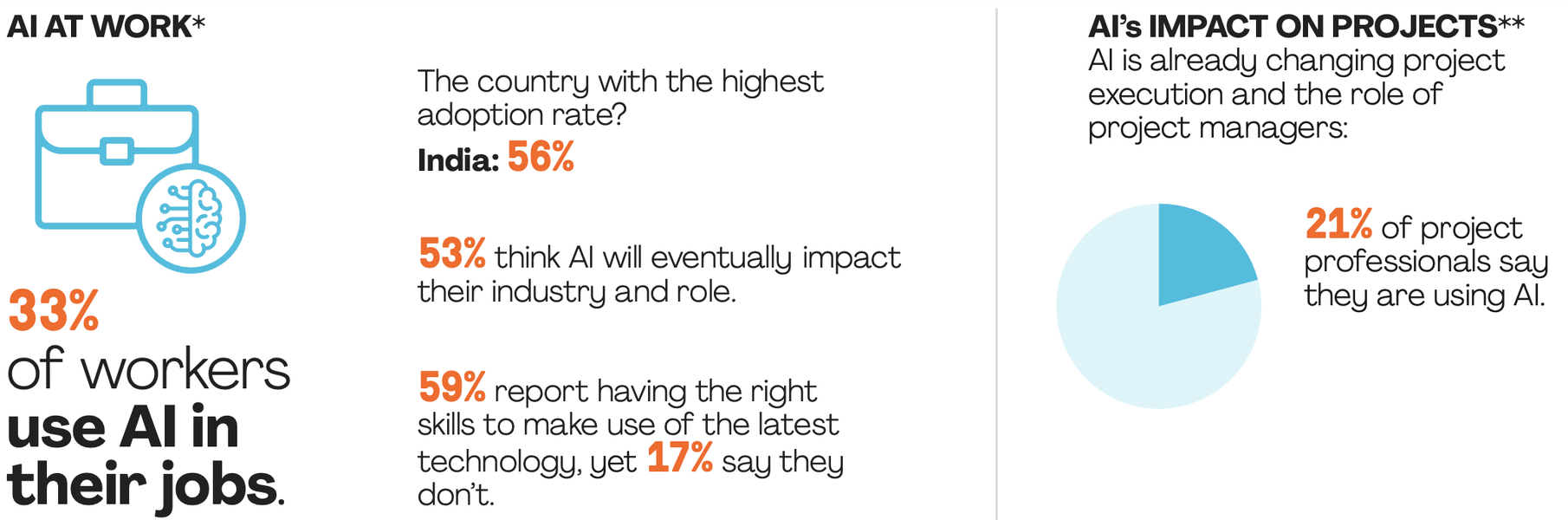
Artificial intelligence (AI) is rapidly transforming the world of project management, according to a new report by the Project Management Institute (PMI). The report, titled “PMI’s Global Project Management Job Trends 2024 Report” found that 33% of workers already use AI in their jobs, and 82% of senior leaders say AI will have at least some impact on projects.

The report also found that there is a significant demand for AI skills, with a 2,000% increase in job postings referencing generative AI skills from March to September 2023. However, there is also a learning gap, with only 13% of employees having been offered AI training.

“The need for upskilling is essential,” the report says. “Sixty percent of older millennials (ages 35-44) say upskilling in AI will be essential, and 91% of respondents believe AI will have at least a moderate impact on the project management profession.”

The report’s findings suggest that AI is having a major impact on project management, and that this trend is likely to continue. Project managers who want to stay ahead of the curve will need to develop their AI skills.

Here are some key takeaways from the PMI report:

  • AI is already being used by a significant number of workers (33%).
  • Senior leaders believe that AI will have a major impact on projects (82%).
  • There is a high demand for AI skills (job postings for generative AI skills increased by 2,000% from March to September 2023).
  • There is a learning gap in AI skills (only 13% of employees have been offered AI training).
  • Upskilling in AI is essential for project managers who want to stay ahead of the curve (60% of older millennials say that upskilling in AI will be essential).

The PMI report is a valuable resource for project managers who are interested in learning more about the impact of AI on their profession. The report’s findings suggest that AI is here to stay, and that project managers who want to be successful in the future will need to develop their AI skills.