
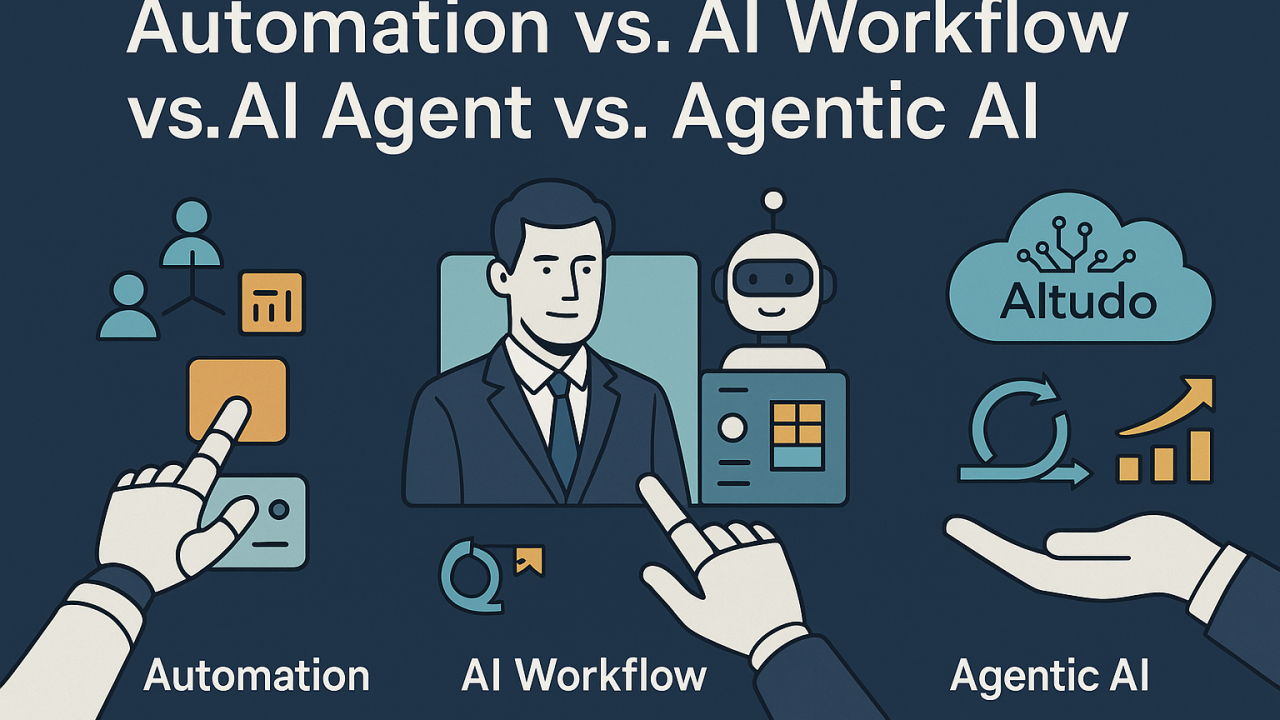
Automation, AI Workflow, AI Agent, Agentic AI: Let’s demystify the madness

In today’s whirlwind of tech buzzwords, it’s easy to feel like automation, AI workflows, AI agents, and Agentic AI are all just fancy ways of saying “robots doing stuff.” Spoiler: they’re not. Each plays a completely different game — from simple task-doers to decision-making, goal-chasing digital minds.

If you’re aiming to  stay relevant and not become obsolete in this AI madness, understand the  isn’t just nice to have, it’s  mission-critical. In this blog,  I’ll break down what each really means, where they shine, where they stumble, and throw in real-world examples and best practices to keep it all grounded (and jargon-free).

Understanding the Basics

1. Automation

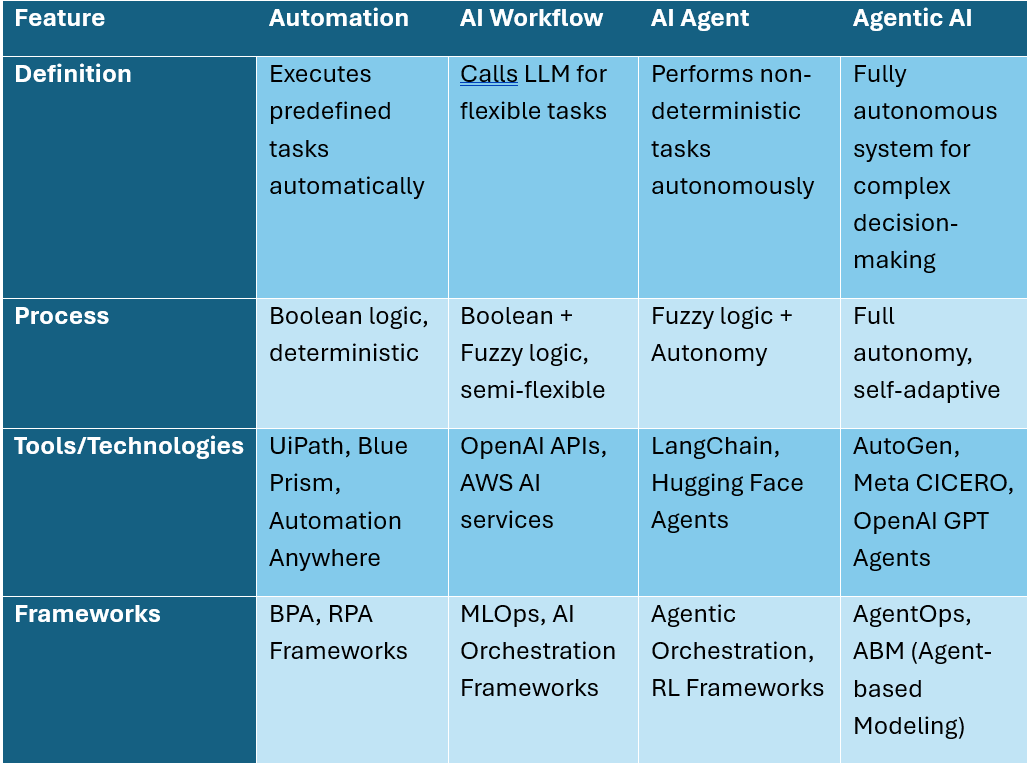
Definition: Automation involves programs that execute predefined, rule-based tasks automatically without any variation.

  • Process: Follows strictly Boolean logic with deterministic paths.
  • Tools/Technologies: RPA (Robotic Process Automation) tools like UiPath, Blue Prism, Automation Anywhere.
  • Frameworks: Business Process Automation (BPA) frameworks.

2. AI Workflow

Definition: An AI workflow calls a large language model (LLM) via an API for one or more flexible steps, improving pattern recognition.

  • Process: Combines Boolean logic with Fuzzy logic.
  • Tools/Technologies: OpenAI API, Hugging Face transformers, AWS AI services.
  • Frameworks: MLOps pipelines, AI orchestration frameworks.

3. AI Agent

Definition: An AI agent is designed to perform non-deterministic, adaptive tasks autonomously, simulating human-like behavior.

  • Process: Driven by Fuzzy logic + Autonomy.
  • Tools/Technologies: LangChain, AutoGPT, Hugging Face Agents.
  • Frameworks: Agentic orchestration platforms, Reinforcement Learning frameworks.

4. Agentic AI

Definition: Agentic AI represents a broader, more advanced system capable of independent decision-making, multi-agent collaboration, and continuous learning.

  • Process: Full autonomy, goal-driven, adaptive multi-agent systems.
  • Tools/Technologies: OpenAI’s GPT Agents, Meta’s CICERO AI, Microsoft’s AutoGen.
  • Frameworks: Agent-based modeling (ABM), AgentOps platforms.

Comparison Table: Automation vs AI Workflow vs AI Agent vs Agentic AI
Article content

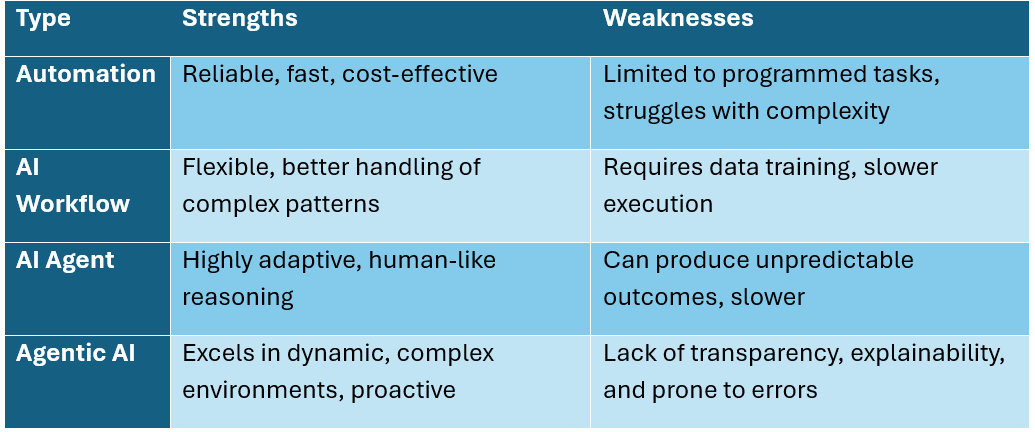
Strengths and Weaknesses Across Systems
Article content

Industry Insights: Where Are We Heading?

According to a recent report by McKinsey, Agentic AI will power the next phase of automation — “decision-making at machine speed.” Industries like healthcare, automotive, and customer service are already seeing early adoption through autonomous vehicles, virtual agents, and dynamic task orchestration.

Some noteworthy applications:

  • Healthcare: AI agents recommending personalized treatment plans.
  • Manufacturing: Autonomous drones handling warehouse logistics.
  • Customer Support: Agentic AI handling customer queries with self-adaptive reasoning.

The future points toward increasingly decentralized, goal-driven AI ecosystems where multiple agents collaborate autonomously without constant human supervision.

As businesses evolve, understanding the distinct capabilities of Automation, AI Workflows, AI Agents, and Agentic AI will determine who leads and who lags behind. The shift from simple automation to complex agentic systems marks not just a technological upgrade — it’s a fundamental transformation in how enterprises operate.

Choosing the right technology depends on the nature of tasks, desired flexibility, risk appetite, and the strategic importance of autonomy
You+AI: Part XVIII: Dynamic Pricing & Product Recommendations

Dynamic pricing, the practice of adjusting prices in real-time based on various factors such as demand, competition, and market conditions, has been around for decades. One of the key advantages of AI-based dynamic pricing is its ability to personalize prices for individual customers. By leveraging data on past purchases, browsing history, demographics, and even psychographic profiles, retailers can tailor prices to match each customer’s willingness to pay. This not only maximizes revenue but also enhances customer satisfaction by offering fair and personalized pricing.

AI-based product recommendations are not limited to just online channels, retailers can seamlessly integrate AI-powered recommendations across various touchpoints, including websites, mobile apps, email campaigns, and even in-store displays. This omnichannel approach ensures a consistent and personalized shopping experience across all channels, thereby maximizing customer engagement and loy

Top AI-based Dynamic Pricing & Product Recommendations tools

Prisync (Dynamic Pricing)

  • Key Features: Real-time competitor price tracking and automatic price adjustments based on market conditions, demand signals, and competitor behavior.
  • Benefits: Increased revenue and profitability, improved competitive advantage, reduced manual pricing tasks.
  • Considerations: Requires accurate product data and integration with your e-commerce platform.

Pricefx (Dynamic Pricing)

  • Key Features: Advanced pricing algorithms, AI-driven demand forecasting, and customer segmentation for personalized pricing strategies.
  • Benefits: Optimized pricing across channels, improved conversion rates, increased customer satisfaction.
  • Considerations: Complex software requiring technical expertise, high pricing for enterprise-level features.

Zilliant (Dynamic Pricing)

  • Key Features: Machine learning-based price optimization, profit maximization algorithms, and dynamic bundling capabilities.
  • Benefits: Improved margins, increased sales volume, data-driven pricing decisions.
  • Considerations: Primarily focused on B2B pricing, high implementation costs.

Rebuy (Product Recommendations)

  • Key Features: AI-powered product recommendations based on user behavior, purchase history, and browsing activity.
  • Benefits: Increased customer engagement, improved conversion rates, personalized shopping experiences.
  • Considerations: Requires integration with e-commerce platform and customer data, may require customization for specific needs.

Twilio Segment (Product Recommendations)

  • Key Features: Real-time product recommendations across multiple channels, including email, SMS, and website pop-ups.
  • Benefits: Personalized marketing campaigns, increased customer lifetime value, improved cross-selling and upselling opportunities.
  • Considerations: Requires integration with CRM and marketing automation platforms, may require technical expertise.

.Coveo Personalized Recommendations (Product Recommendations)

  • Key Features: AI-powered product recommendations for search results, content pages, and email marketing campaigns.
  • Benefits: Improved website navigation, increased click-through rates, enhanced customer engagement.
  • Considerations: Requires integration with website platform and content management system, may require customization for specific needs.

Oracle CX Recommendations (Product Recommendations)

  • Key Features: AI-powered product recommendations across various Oracle CX solutions, including marketing automation and e-commerce platforms.
  • Benefits: Personalized customer experiences, increased conversion rates, improved marketing campaign ROI.
  • Considerations: Requires Oracle CX suite subscription, may be complex to set up and manage.

Additional factors to consider when choosing an AI-based Dynamic Pricing & Product Recommendations tool:

  • Industry and business needs: Consider the specific needs of your industry and business model when choosing a tool.
  • Data availability and quality: Ensure the tool can access and process your customer data effectively.
  • Technical expertise and resources: Evaluate the level of technical expertise required to implement and manage the tool.
  • Budget and pricing model: Compare the pricing models of different tools and choose one that fits your budget.
  • Scalability and flexibility: Consider the tool’s ability to scale with your business growth and adapt to changing needs.

By harnessing the power of AI, retailers can stay ahead of the competition, delight customers, and thrive in an increasingly complex and competitive marketplace. As AI technology continues to evolve, the possibilities for innovation and transformation in retail are virtually limitless.

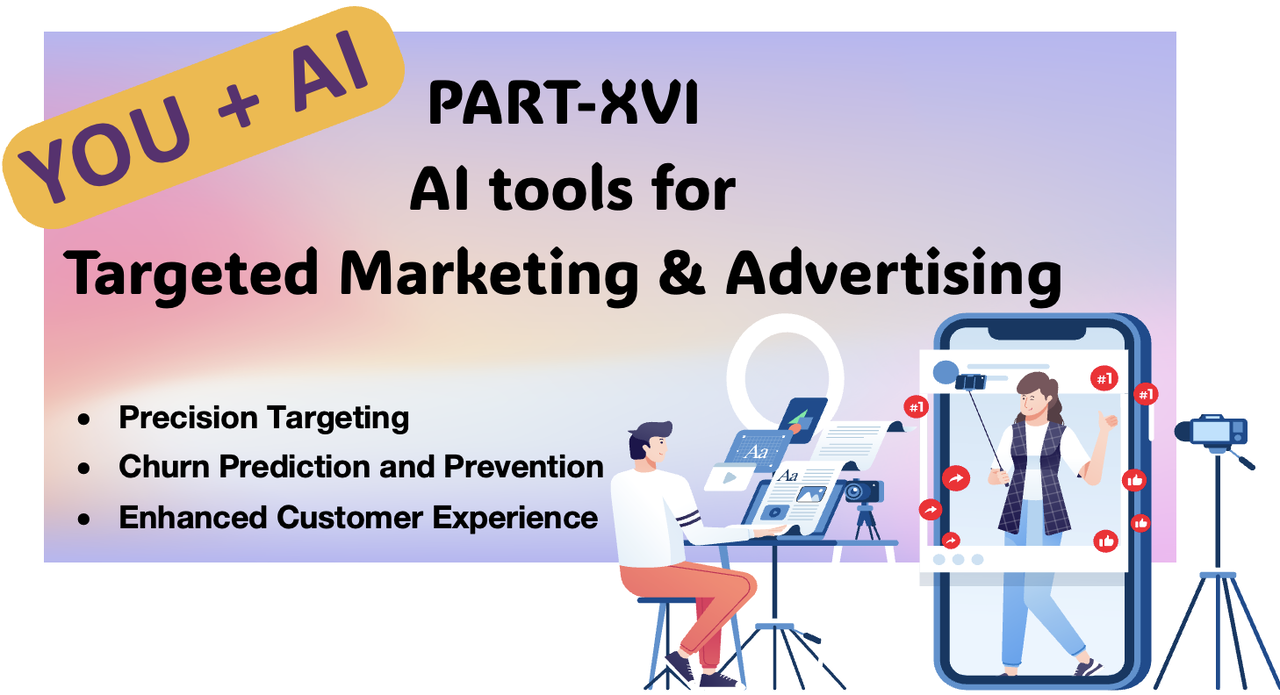
You+AI: Part XVII : Targeted Marketing & Advertising

AI technologies have revolutionized the way businesses connect with their target audience, enabling hyper-personalized campaigns and enhancing customer engagement. Among the myriad applications of AI in marketing, targeted marketing and advertising stand out as key areas where AI’s capabilities are leveraged to deliver precise and effective messaging to specific consumer segments.

Let’s delve into the realm of AI-based targeted marketing and advertising, exploring its significance, benefits, and the top tools reshaping the landscape.

Significance of AI in Targeted Marketing & Advertising:

AI has ability to analyze vast amounts of data, identify patterns, and predict consumer behavior with remarkable accuracy. By leveraging AI algorithms, marketers can gain deeper insights into consumer preferences, interests, and purchase intent, enabling them to tailor campaigns that resonate with individual customers on a personal level.

Benefits of AI-Based Targeted Marketing & Advertising:

  1. Precision Targeting: AI algorithms can analyze demographic, behavioral, and psychographic data to identify and target specific audience segments, ensuring that marketing messages reach the most receptive audience.
  2. Personalization: AI enables dynamic content creation and personalized recommendations based on individual preferences, enhancing engagement and driving conversion rates.
  3. Optimized Campaigns: AI-powered analytics provide real-time insights into campaign performance, allowing marketers to optimize their strategies for better ROI and conversion rates.
  4. Cost Efficiency: By targeting the right audience with precision, AI-based marketing reduces wasteful ad spend, maximizing the efficiency of marketing budgets.
  5. Enhanced Customer Experience: Personalized communication and tailored offers result in a more enjoyable and relevant customer experience, fostering brand loyalty and advocacy.

Top AI-based Targeted Marketing & Advertising tools

Albert.ai: This platform uses AI to analyze vast amounts of user data and create personalized advertising campaigns across various channels, optimizing targeting and maximizing ROI.

Criteo AI Engine: Leveraging AI, Criteo personalizes display advertising and retargeting campaigns, offering dynamic creative optimization and audience prediction for improved ad performance.

Optimizely: Optimizely’s AI-driven experimentation platform enables marketers to test and optimize various aspects of their campaigns, from ad creatives to landing pages, to maximize conversion rates.

Epsilon PeopleCloud: Combines AI with advanced data management and analytics to identify high-value customer segments and deliver targeted advertising through various channels.

Adobe Advertising Cloud: This suite integrates AI across its advertising solutions, offering features like audience segmentation, predictive modeling, and real-time campaign optimization.

Facebook Dynamic Creative Optimization: Utilizing AI, Facebook automatically generates and tests ad variations, selecting the best-performing combination to maximize campaign reach and impact.

Google Audience Insights: This free tool from Google leverages AI to analyze audience demographics, interests, and online behavior, providing valuable insights for targeted advertising campaigns.

Amazon DSP: This programmatic advertising platform utilizes AI for audience targeting, bidding optimization, and campaign performance analysis, delivering targeted ads across Amazon properties and partner networks.

Xandr Monetize: This platform by IPG uses AI to optimize ad inventory management, targeting, and pricing strategies, maximizing value for publishers and advertisers.

Neustar Identity Link: This tool leverages AI to connect fragmented customer data across multiple channels, enabling precise audience targeting and personalized omnichannel marketing experiences.

Additional factors to consider when choosing an AI-based Targeted Marketing & Advertising tool:

  • Campaign goals and budget: Identify your specific goals (e.g., brand awareness, lead generation, website traffic) and choose a tool that aligns with your budget and objectives.
  • Target audience complexity: Consider the complexity of your target audience and the tool’s ability to create highly refined segments for effective targeting.
  • Data integration capabilities: Ensure the tool seamlessly integrates with your existing marketing and customer data sources.
  • Reporting and analytics: Evaluate the tool’s reporting and analytics capabilities to monitor campaign performance and optimize future strategies.
  • Compliance and data privacy: Verify the tool adheres to relevant data privacy regulations and security standards.

Remember, the ideal tool for you depends on your unique marketing needs, target audience, and technical environment. Evaluate different options and select the one that best empowers you to create targeted and impactful advertising campaigns that drive your business goals.

By harnessing the power of AI-driven tools and technologies, marketers can unlock new opportunities for growth, innovation, and customer satisfaction in an increasingly competitive landscape.