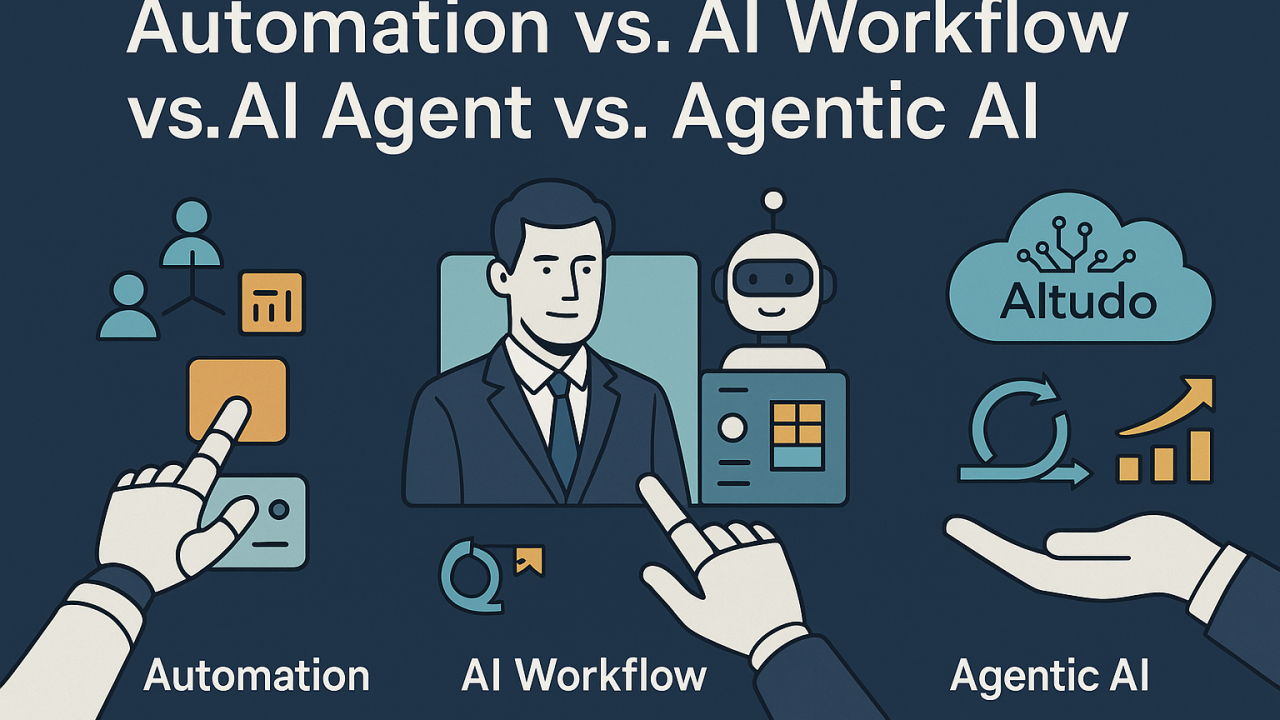
Automation, AI Workflow, AI Agent, Agentic AI: Let’s demystify the madness

In today’s whirlwind of tech buzzwords, it’s easy to feel like automation, AI workflows, AI agents, and Agentic AI are all just fancy ways of saying “robots doing stuff.” Spoiler: they’re not. Each plays a completely different game — from simple task-doers to decision-making, goal-chasing digital minds.

If you’re aiming to  stay relevant and not become obsolete in this AI madness, understand the  isn’t just nice to have, it’s  mission-critical. In this blog,  I’ll break down what each really means, where they shine, where they stumble, and throw in real-world examples and best practices to keep it all grounded (and jargon-free).

Understanding the Basics

1. Automation

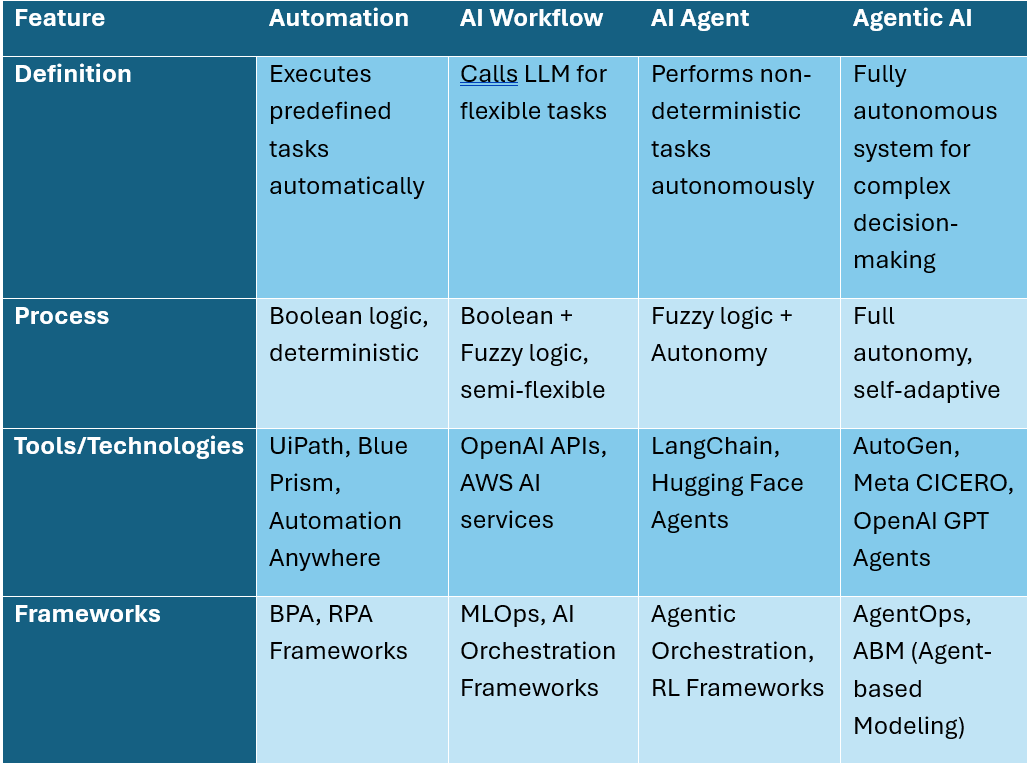
Definition: Automation involves programs that execute predefined, rule-based tasks automatically without any variation.

  • Process: Follows strictly Boolean logic with deterministic paths.
  • Tools/Technologies: RPA (Robotic Process Automation) tools like UiPath, Blue Prism, Automation Anywhere.
  • Frameworks: Business Process Automation (BPA) frameworks.

2. AI Workflow

Definition: An AI workflow calls a large language model (LLM) via an API for one or more flexible steps, improving pattern recognition.

  • Process: Combines Boolean logic with Fuzzy logic.
  • Tools/Technologies: OpenAI API, Hugging Face transformers, AWS AI services.
  • Frameworks: MLOps pipelines, AI orchestration frameworks.

3. AI Agent

Definition: An AI agent is designed to perform non-deterministic, adaptive tasks autonomously, simulating human-like behavior.

  • Process: Driven by Fuzzy logic + Autonomy.
  • Tools/Technologies: LangChain, AutoGPT, Hugging Face Agents.
  • Frameworks: Agentic orchestration platforms, Reinforcement Learning frameworks.

4. Agentic AI

Definition: Agentic AI represents a broader, more advanced system capable of independent decision-making, multi-agent collaboration, and continuous learning.

  • Process: Full autonomy, goal-driven, adaptive multi-agent systems.
  • Tools/Technologies: OpenAI’s GPT Agents, Meta’s CICERO AI, Microsoft’s AutoGen.
  • Frameworks: Agent-based modeling (ABM), AgentOps platforms.

Comparison Table: Automation vs AI Workflow vs AI Agent vs Agentic AI

Article content

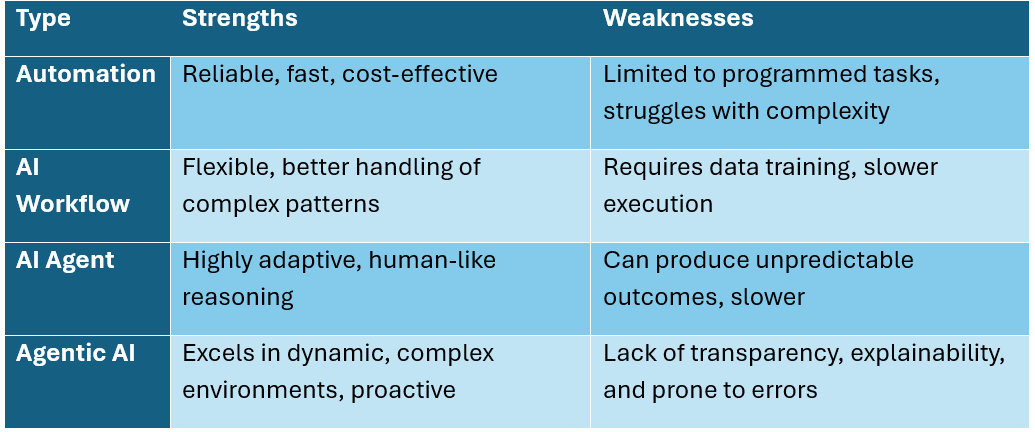
Strengths and Weaknesses Across Systems

Article content

Industry Insights: Where Are We Heading?

According to a recent report by McKinsey, Agentic AI will power the next phase of automation — “decision-making at machine speed.” Industries like healthcare, automotive, and customer service are already seeing early adoption through autonomous vehicles, virtual agents, and dynamic task orchestration.

Some noteworthy applications:

  • Healthcare: AI agents recommending personalized treatment plans.
  • Manufacturing: Autonomous drones handling warehouse logistics.
  • Customer Support: Agentic AI handling customer queries with self-adaptive reasoning.

The future points toward increasingly decentralized, goal-driven AI ecosystems where multiple agents collaborate autonomously without constant human supervision.

As businesses evolve, understanding the distinct capabilities of Automation, AI Workflows, AI Agents, and Agentic AI will determine who leads and who lags behind. The shift from simple automation to complex agentic systems marks not just a technological upgrade — it’s a fundamental transformation in how enterprises operate.

Choosing the right technology depends on the nature of tasks, desired flexibility, risk appetite, and the strategic importance of autonomy

Scaling Gen AI: Insights, Techniques, and Best Practices for Handling Unstructured Data

The advent of generative AI (gen AI) offers a transformative opportunity for organizations to leverage advanced data analytics and automation. This shift necessitates robust data platforms and a strategic approach to managing both structured and unstructured data. To successfully integrate gen AI capabilities, organizations must focus on data quality, efficient data management, and strong security protocols.

McKinsey recently published a report titled “A data leader’s technical guide to scaling gen AI”.

Key Insights from the McKinsey’s Guide

Enhancing Data Quality:

  • Accuracy and Relevance: High-quality data is critical to avoid inaccurate AI outputs, costly corrections, and potential security risks.
  • Managing Unstructured Data: Tools like knowledge graphs and multimodal models can help manage complex data relationships and formats.

Creating and Managing Data Products:

  • End-to-End Data Product Creation: Automation in creating data pipelines and products can significantly reduce time and increase scalability.
  • Synthetic Data Generation: Generative AI tools can create synthetic data for testing and development, especially in highly regulated industries like healthcare.

Improving Data Management:

  • Orchestration and Modularity: Utilizing agent-based frameworks ensures consistency and reusability in managing gen AI applications.
  • Data Catalogs and Metadata Tagging: Gen AI-augmented data catalogs can enhance real-time metadata tagging and data discovery.

Security and Coding Standards:

  • Data Security: Implementing modularized pipelines with robust security controls is essential for handling unstructured data.
  • Integrating Coding Best Practices: Ensuring that gen AI-generated code adheres to organizational standards helps maintain quality and consistency.

Techniques for Integrating Gen AI

Enhanced Data Pipelines:

  • Medallion Architecture: A medallion architecture helps organize data and supports modular pipeline development, aiding in the integration of gen AI capabilities. Read more about MedallionArchitecture Read more about data modelling design patterns(technical experience required to grasp the concepts)
  • Automated Evaluation Methods: Automated methods to evaluate and score data relevancy can enhance the accuracy of AI outputs.

Utilizing Synthetic Data:

  • Test Data Generation: Synthetic data can be used to test and validate new functionalities, safeguarding real data.

End-to-End Automation:

Data Orchestration:

Best Practices for Handling Unstructured Data

Modular Data Security:

Role-Based Access Control: Implementing role-based access controls at each checkpoint in the data pipeline ensures secure handling of unstructured data.

Data Cataloging and Metadata Management:

Automated Metadata Generation: Gen AI can automatically generate metadata from unstructured content, improving data management and discovery.

Coding Standards Integration:

Quality Assurance: Reviewing and integrating gen AI-generated code with existing coding standards is crucial for maintaining data quality and consistency.

Continuous Monitoring and Evaluation:

Regular Audits: Conducting regular audits of data pipelines and gen AI outputs helps identify and address issues promptly.

Integrating generative AI into organizational systems presents both challenges and opportunities. By focusing on data quality, employing advanced data management techniques, and ensuring robust security measures, organizations can fully realize the potential of gen AI.

YOU+AI : Part XXV: AI: Paving the Path Forward Together

The “You + AI” article series has been a collaborative voyage into a future teeming with challenges and opportunities. Throughout the journey, we delved deep into the ways AI is reshaping product and project development, as well as its personal and professional impacts. Across 24 articles, we navigated through various tools, frameworks, and strategies for integrating AI into our everyday work practices.

In addition to practical applications, the series also dedicated 25 articles to exploring the ethical considerations, risks, and opportunities posed by AI. We examined the potential threats and discussed ways to mitigate them, ensuring that as we embrace AI, we do so responsibly and with foresight. Through this comprehensive exploration, we aimed to equip readers with the knowledge and insights needed to navigate the evolving landscape of AI integration effectively.

The YOU in “You + AI”

The future of AI is not predetermined; it’s a story we write together. As individuals, we can shape this narrative by:

  • Embracing Lifelong Learning: Continuous learning will be key to thriving in a rapidly evolving world.
  • Demanding Ethical AI: Hold companies and institutions accountable for developing and deploying AI responsibly.
  • Contributing to the Conversation: Engage in discussions about the future of AI, ensuring everyone has a voice in shaping this powerful technology.

From Chatting to Shaping the World:

After ChatGPT, AI didn’t just get better at conversations; it started touching every part of our lives. It helps us predict trends in finance, improve healthcare, and make many things more efficient. As AI keeps growing, it’s not just one thing anymore. It’s a mix of different technologies working together. Think of it as a conductor leading a symphony, but instead of musicians, it orchestrates computers and devices to create something amazing.

The Evolving Partnership:

Fast forward to today, 2024. LLMs have become ubiquitous. They power our virtual assistants, personalize our news feeds, and even assist doctors with medical diagnoses. The initial fear of AI replacing humans has largely subsided. Instead, a collaborative approach has taken root.

Consider a doctor utilizing an LLM to analyze patient data and generate preliminary reports. The doctor, armed with this information, can then focus on personalized patient interaction and complex decision-making. This synergy exemplifies the future of human-AI collaboration.

The Challenges We Face:

This path isn’t without its hurdles. Bias in training data can lead to discriminatory outputs from LLMs. The potential for misuse of this technology for malicious purposes is a concern. The question of job displacement due to automation looms large. Addressing these challenges will require a multi-pronged approach:

  • Ethical Development: Robust ethical frameworks for LLM development and deployment are crucial. Transparency in training data and algorithms is essential to mitigate bias.
  • Reskilling and Upskilling: As AI automates tasks, human workers will need to develop new skills to stay relevant. Educational programs need to adapt to equip individuals for the jobs of tomorrow.
  • Regulation and Oversight: Governments worldwide will need to establish regulations to prevent the misuse of AI and ensure the responsible development of this powerful technology.

A Glimpse into the Future:

Let’s take a leap forward and imagine the year 2030. AI has permeated every facet of our lives.

  • Personalized Education: AI tutors tailor learning experiences to individual student needs, bridging learning gaps and fostering deeper understanding.
  • Augmented Creativity: AI assists artists, writers, and musicians in their creative endeavors, generating ideas, brainstorming concepts, and refining artistic output.
  • Scientific Breakthroughs: AI becomes a powerful tool for scientific discovery, analyzing vast datasets, simulating complex scenarios, and accelerating research and development.

Looking Ahead:

So, what does the future hold? Well, imagine AI that can solve problems even faster than it does now. That’s where quantum AI comes in. It’s like giving AI superpowers, allowing it to tackle complex challenges beyond our current abilities. Then there’s neuromorphic AI, which mimics how our brains work. This could lead to AI that thinks more like us, opening up new possibilities in how we interact with technology.

In the realm of creativity, AI is becoming quite the artist. It can compose music, create art, and even tell stories. Imagine collaborating with AI to bring your wildest ideas to life. It’s like having a creative partner who’s always full of fresh ideas.

As I wrap up our exploration of “You+AI” series, we stand on the brink of an exciting future. The lines between human and machine are blurring, and new opportunities await. But as we journey forward, let’s remember to tread carefully, keeping in mind our values and the well-being of all. With AI as our ally, we can become a force for positive change with AI empowering us to build a brighter future for generations to come.

YOU+AI : Part XXIV: The Future of Work with AI: Collaboration or Competition?

As AI technologies continue to advance, the question arises: will AI be a collaborator, augmenting human capabilities, or a competitor, replacing human labor? This article delves into the future of work with AI, exploring whether it will foster collaboration or intensify competition, backed by real-world cases and expert predictions.

However, a growing chorus of experts believe AI’s impact will be more nuanced. Rather than replacing human workers altogether, AI is more likely to augment our capabilities.

Here’s why:

  • Limited AI Scope: Current AI excels at specific tasks, but it lacks the human ability for broad-based problem-solving, critical thinking, and creativity. For instance, an AI-powered radiology assistant can analyze X-rays with impressive accuracy, but it cannot diagnose a patient or determine the best course of treatment – that requires the expertise of a human doctor.
  • Human-AI Synergy: Imagine a team where AI handles data analysis and report generation, freeing up doctors to focus on patient interaction and complex diagnoses. This collaboration can lead to more efficient and effective healthcare delivery.
  • New Opportunities: AI is also creating entirely new job categories. Data scientists, AI ethicists, and cybersecurity specialists are just a few examples. The World Economic Forum estimates that by 2030, AI could create up to 97 million new jobs globally.

The Promise of Collaboration:

AI holds immense potential to collaborate with humans, augmenting their capabilities and improving productivity across various sectors. Here are some examples:

Healthcare: AI-powered diagnostic tools assist medical professionals in analyzing complex data, leading to more accurate diagnoses and personalized treatment plans. For instance, IBM’s Watson for Oncology analyzes patient data and medical literature to recommend cancer treatment options, collaborating with oncologists to deliver better patient outcomes.

Customer Service: Chatbots equipped with natural language processing (NLP) capabilities handle routine customer inquiries, freeing human agents to focus on more complex issues. Companies like Bank of America and Amtrak utilize AI chatbots to provide instant support and enhance customer satisfaction.

Education: AI-driven personalized learning platforms adapt to students’ individual needs, providing tailored learning experiences and improving educational outcomes. Duolingo, for instance, employs AI algorithms to customize language learning paths for users, collaborating with learners to achieve their language proficiency goals.

Manufacturing: Collaborative robots, or cobots, work alongside human workers on factory floors, increasing efficiency and safety. Companies like BMW and Adidas use cobots for tasks such as assembly and quality control, augmenting human labor rather than replacing it.

Real World Collaboration:

Several companies are already demonstrating the power of human-AI collaboration:

The Threat of Competition:

Despite its collaborative potential, AI also poses challenges, potentially leading to job displacement and heightened competition. Here are examples illustrating this aspect:

Retail: Automated checkout systems and AI-powered inventory management solutions reduce the need for human cashiers and stock clerks. Amazon Go stores, which feature cashierless checkout technology, demonstrate how AI can streamline retail operations while minimizing human involvement.

Transportation: Self-driving vehicles powered by AI threaten jobs in the transportation sector, including truck driving and taxi services. Companies like Tesla and Waymo are investing heavily in autonomous vehicle technology, potentially disrupting the livelihoods of millions of drivers worldwide.

Finance: AI algorithms handle tasks such as algorithmic trading and risk assessment in the finance industry, diminishing the demand for human traders and analysts. High-frequency trading firms like Renaissance Technologies leverage AI to make split-second trading decisions, often outperforming human traders.

Legal Services: AI-powered legal research tools sift through vast amounts of case law and precedents, reducing the need for junior lawyers to perform manual document review. Platforms like ROSS Intelligence and Lex Machina enable law firms to streamline their workflows and deliver legal services more efficiently.

Expert Predictions:

Industry experts offer diverse perspectives on the future of work with AI:

The Road Ahead

The future of work with AI will likely be a story of collaboration, not competition. However, navigating this transition will require proactive measures from both individuals and organizations:

  • Lifelong Learning: Embracing a growth mindset and continuous learning will be essential for workers to remain relevant in the evolving job market.
  • Reskilling and Upskilling Programs: Organizations can help their employees bridge the skills gap by offering training programs focused on AI and emerging technologies.
  • Ethical Considerations: As AI becomes more integrated into the workplace, ethical considerations like bias and transparency need to be addressed to ensure a fair and equitable work environment.

The future of work with AI presents both opportunities and challenges. While AI has the potential to collaborate with humans, enhancing productivity and innovation, it also poses threats of job displacement and heightened competition. To navigate this landscape successfully, individuals and organizations must embrace lifelong learning, adaptability, and proactive strategies for leveraging AI technologies. By fostering a symbiotic relationship between humans and AI, we can shape a future where collaboration triumphs

By embracing collaboration, continuous learning, and ethical considerations, we can ensure that AI becomes a powerful tool for human progress, not a threat to our jobs.

YOU+AI : Part XXIII: Upskilling in the Age of AI: Strategies for Success

Integration of artificial intelligence (AI) into various industries has brought forth unprecedented opportunities and challenges. With AI technologies automating tasks across sectors, there’s a growing demand for individuals to upskill and reskill to stay relevant in the job market.

Upskilling in the age of AI is not just a matter of personal development; it’s a necessity for thriving in a world where technological advancements are reshaping job roles and requirements. Let’s delve into some effective strategies for navigating this era of AI-driven transformation.

Understanding the Importance of Upskilling

Before diving into strategies, it’s essential to grasp why upskilling is crucial in the age of AI. AI has the potential to augment human capabilities, making processes more efficient and enabling individuals to focus on higher-value tasks.

However, it also poses a threat to traditional job roles, as automation replaces repetitive tasks. Therefore, upskilling becomes imperative to adapt to these changes, remain competitive, and seize new opportunities that arise from AI integration.

Strategies for Upskilling in the Age of AI

  • Identify Relevant Skills: Begin by identifying the skills that are most in-demand in your industry or desired field. This may include technical skills like data analysis, programming, machine learning, or soft skills such as critical thinking, creativity, and adaptability. Tools like LinkedIn Learning, Coursera, and Udacity offer courses tailored to specific skills and industries.
  • Continuous Learning: Embrace a mindset of lifelong learning. AI technologies evolve rapidly, and staying updated with the latest advancements is crucial. Platforms like Kaggle, GitHub, and Stack Overflow provide access to real-world projects, datasets, and collaborative learning opportunities.
  • Hands-On Experience: Theory alone isn’t sufficient; practical experience is paramount. Seek internships, freelance projects, or volunteer opportunities where you can apply your newfound skills in real-world scenarios. Building a portfolio of projects demonstrates your capabilities to potential employers.
  • Collaborative Learning Communities: Engage with communities of like-minded individuals who are also upskilling in AI-related fields. Participate in forums, attend workshops, and join meetups or online groups such as AI Saturdays, Women in Machine Learning & Data Science, or local tech meetups.
  • Mentorship and Networking: Connect with experienced professionals in AI or related fields who can offer guidance and mentorship. Networking platforms like LinkedIn can facilitate these connections. Mentors can provide valuable insights, career advice, and help navigate the complexities of upskilling.
  • Specialized Certification Programs: Consider enrolling in specialized certification programs offered by reputable institutions or organizations. Certifications in AI, such as Google’s TensorFlow Developer Certificate or Microsoft’s AI Engineer Certification, validate your expertise and enhance your credibility in the job market.
  • Adaptability and Resilience: Cultivate adaptability and resilience as core traits. The job market is dynamic, and unexpected changes are inevitable. Being adaptable allows you to pivot quickly and thrive in diverse environments, while resilience helps you bounce back from setbacks and challenges.

Upskilling Initiatives

  • IBM’s SkillsBuild: IBM’s SkillsBuild platform provides free learning resources and personalized learning paths in areas such as AI, cloud computing, cybersecurity, and data science. It offers hands-on labs, virtual mentoring, and industry-recognized certifications to help individuals acquire relevant skills.
  • Google’s Grow with Google: Google’s Grow with Google initiative offers a variety of free training programs and resources to help individuals grow their skills in digital marketing, data analysis, machine learning, and more. It includes courses, workshops, and online tools to support lifelong learning and career advancement.
  • Microsoft’s AI Business School: Microsoft’s AI Business School offers resources and case studies to help business leaders understand and implement AI technologies in their organizations. It covers topics such as AI strategy, responsible AI, and building an AI-ready culture, catering to both technical and non-technical audiences.

Frameworks and Tools for Upskilling

  • Frameworks: Frameworks such as the AI Capability Framework by the AI Forum of New Zealand provide a structured approach for organizations and individuals to assess their AI capabilities and identify areas for development. These frameworks offer guidance on skills, processes, and governance required for AI adoption.
  • Tools: Tools like TensorFlow, PyTorch, and scikit-learn are widely used in AI development and machine learning. Online platforms such as GitHub and GitLab facilitate collaborative coding and version control, while cloud platforms like AWS, Google Cloud, and Microsoft Azure offer scalable infrastructure for AI projects.

In the age of AI, upskilling is not just an option; it’s a necessity for individuals and organizations alike. By adopting a proactive approach to learning, embracing continuous improvement, and leveraging available resources and networks, individuals can stay ahead of the curve and thrive in a rapidly evolving job market. Upskilling in AI opens doors to new opportunities, empowers individuals to contribute meaningfully to the advancement of technology, and ensures a sustainable future in the digital era.

YOU+AI : Part XXII: The Future of Work: Embracing AI Transformation

The rapid advancement of Artificial Intelligence (AI) technologies has sparked widespread concerns about its potential to replace human jobs. However, rather than viewing AI as a threat, organizations must recognize it as a transformative force that reshapes the workforce and creates new opportunities. This article delves into the fears surrounding AI’s disruptive potential, explores the evolving roles within organizations, stresses the importance of upskilling, and provides strategies for workforce adaptation in an AI-driven economy.

Additionally, it highlights processes, frameworks, tools, and technologies that complement AI growth and aid in reshaping the workforce.

According to  IBM, 40% of the workforce needs reskilling in next 3 years

Addressing the Fears:

The fear of AI displacing human jobs is not unfounded. Automation and AI technologies have already begun to replace routine and repetitive tasks across various industries.

  • Automation is inevitable. AI and automation have already begun replacing routine and repetitive tasks across various industries.
  • History suggests job creation. However, history has shown that technological advancements tend to create more jobs than they replace. These new jobs will be different, requiring new skillsets.
  • Shifting focus. AI frees up humans to focus on higher-value activities that require creativity, critical thinking, emotional intelligence, and complex problem-solving.

Here are some additional points to consider:

  • Transparency and communication. Organizations can address fears by openly communicating about AI implementation plans and how they will impact the workforce. Town halls, Q&A sessions, and clear communication channels can help to ease anxieties.
  • Focus on reskilling. Providing opportunities for employees to upskill and reskill in areas complementary to AI will go a long way in assuaging fears. This demonstrates a commitment to the workforce and helps employees see a future for themselves in the organization.
  • Addressing job displacement. While the overall impact of AI on jobs may be positive, there will be some job displacement. It is important to have plans in place to support impacted workers, such as severance packages, outplacement services, and retraining programs

Embracing Change: Processes, Frameworks, and Tools for Workforce Adaptation

To navigate this change effectively, organizations and individuals must adopt a strategic approach. Here are key aspects to consider:

  • Process Reimagination: Identify tasks ripe for automation and redesign workflows to optimize human-AI collaboration. Tools like process mining can identify repetitive tasks that AI can handle.
  • Skills Gap Analysis: Assess current workforce skillsets and identify areas for upskilling and reskilling. Leverage learning management systems (LMS) to deliver targeted training programs.
  • Culture of Continuous Learning: Foster a culture that embraces lifelong learning. Encourage employees to explore online courses, attend workshops, and stay updated with emerging technologies.

Complementary Technologies and Tools:

Several technologies can empower a future-proof workforce alongside AI:

  • Big Data and Analytics: Data analysis skills are crucial for extracting insights from the vast amount of data generated by AI systems. Business intelligence (BI) tools can present data in a user-friendly format.
  • Cloud Computing: Cloud platforms provide scalable and secure environments for deploying and managing AI applications, making them accessible to a wider range of workers.

Frameworks for Successful Implementation:

Frameworks can guide the development and implementation of AI-driven workforce strategies.

Here are two prominent approaches:

The Jobs to Be Done (JTBD) Framework:

This framework focuses on the underlying needs that jobs fulfill, rather than specific tasks. By understanding these needs, organizations can identify tasks for automation while ensuring human workers remain focused on higher-value activities.

Let’s delve deeper into how JTBD can be applied in the context of AI:

  • Understanding the Core Needs, Not Just Tasks:

Traditional approaches to workforce transformation often focus on automating specific tasks. However, the JTBD framework shifts the focus to the underlying needs that jobs fulfill. This allows us to identify tasks best suited for automation while ensuring human workers remain focused on higher-value activities.

Here’s how JTBD can be applied in the AI context:

  • Identifying Jobs to be Done: Define the core needs that current jobs fulfill. For example, an accountant’s job might involve the “job” of ensuring financial accuracy.
  • Understanding the Progress: Analyze how existing processes and tools help or hinder the completion of these jobs. Is data entry slowing down the accountant’s ability to ensure accuracy?
  • AI as a Tool: Identify tasks within the job that AI can automate. For example, AI can automate data entry and basic calculations, freeing up the accountant to focus on complex financial analysis and client communication.

Benefits of JTBD in AI Integration:

  • Targeted Automation: By focusing on core needs, AI is deployed strategically to automate tasks that hinder progress, not replace the entire job.
  • Human-Centered Approach: JTBD ensures that human workers remain focused on the “why” behind the tasks, leveraging their unique skills for problem-solving, judgment, and creativity.
  • Future-Proofing the Workforce: By analyzing core needs, organizations can identify skills that will remain valuable in an AI-driven future. Upskilling and reskilling programs can be tailored to develop these crucial competencies.

Jobs-to-be-Done (JTBD) in IT Project Management

The JTBD framework can be a valuable tool for understanding the core needs of IT project management and how AI can be used to augment human expertise. Here’s an example:

  • Resource Allocation: AI-powered tools can analyze team member skillsets, workload, and past performance to suggest the most efficient resource allocation for project tasks.
  • Risk Management: AI algorithms can analyze project data to identify potential risks early on and suggest mitigation strategies.
  • Project Monitoring: Real-time dashboards powered by AI can provide project managers with a holistic view of progress, budget, and potential roadblocks.

Human Expertise Remains Crucial:

While AI plays a significant role, human expertise remains essential in IT project management. Project managers still need to:

  • Set Project Vision and Goals: Define the project’s overall objectives and ensure alignment with organizational goals.
  • Manage Stakeholder Relationships: Communicate effectively with stakeholders, manage expectations, and address concerns.
  • Lead and Motivate Teams: Motivate and inspire team members, fostering a collaborative and productive work environment.

The Future of Work Framework:

Developed by the McKinsey Global Institute, this framework identifies three key workforce strategies for the AI age: reskilling and upskilling, automation adoption with human-in-the-loop processes, and job redesign.

This framework isn’t a one-size-fits-all solution, but rather a collection of interconnected strategies that can be customized to an organization’s specific needs. Let’s delve into the key pillars of the Future of Work Framework:

1. Redefining Talent:

Gone are the days when a single skillset could guarantee a long-term career. The Future of Work Framework emphasizes a shift towards a growth mindset and continuous learning. Organizations need to:

  • Identify in-demand skills: Analyze future industry trends and identify the skills that will be crucial for success.
  • Invest in upskilling and reskilling: Provide training programs and resources for employees to develop new competencies in areas like AI literacy, data analysis, and critical thinking.
  • Embrace diverse talent pools: Look beyond traditional hiring practices and consider the value of freelancers, gig workers, and remote teams.

2. Designing for Agility and Impact:

The Future of Work demands a culture that embraces adaptability and thrives on change. Organizations need to:

  • Break down silos: Encourage cross-functional collaboration and information sharing between teams.
  • Embrace experimentation: Create a culture that encourages innovation and experimentation with new technologies and workflows.
  • Focus on outcomes, not just outputs: Shift the focus from activity to results, empowering employees to achieve goals in creative and efficient ways.

3. Deploying Talent and Mobilizing Careers:

The traditional “one-job-for-life” model is giving way to a more fluid and dynamic career landscape. The Future of Work Framework encourages:

  • Internal talent mobility: Provide opportunities for employees to move between departments and take on new challenges within the organization.
  • Personalized career development: Work with employees to identify their career aspirations and create personalized development plans.
  • Flexible work arrangements: Offer remote work options, flexible hours, and other arrangements that cater to the diverse needs of a modern workforce.

4. Prioritizing Digital Transformation:

Digital technologies are transforming the way we work. The Future of Work Framework highlights the importance of:

  • Investing in the right tools: Provide employees with the tools and technologies they need to be productive and efficient.
  • Data-driven decision-making: Leverage data analytics to gain valuable insights and make informed decisions about the workforce and the organization’s future.
  • Cybersecurity and data privacy: Implement robust cybersecurity measures to protect sensitive data and ensure employee privacy.

Strategies for Workforce Adaptation:

To thrive in an AI-driven economy, organizations need to adopt strategic approaches to workforce adaptation. This includes:

  • Talent Acquisition and Retention: Recruiters should prioritize candidates with a blend of technical skills, domain expertise, and soft skills such as creativity, empathy, and adaptability. Additionally, organizations must focus on retaining existing talent by providing opportunities for upskilling and career advancement.
  • Collaborative Work Environments: Foster collaboration between humans and AI systems by creating inclusive work environments where employees feel empowered to contribute their unique skills and insights. Encourage cross-functional teams to leverage AI technologies for innovation and problem-solving.
  • Ethical AI Implementation: Ensure that AI systems are deployed ethically and responsibly, taking into account potential biases, privacy concerns, and societal implications. Establish clear guidelines and frameworks for AI governance, transparency, and accountability
  • Lifelong Learning Culture: Cultivate a culture of continuous learning and development, where employees are encouraged to pursue learning opportunities both within and outside the organization. Provide access to online courses, certifications, and mentorship programs to support ongoing skill development

In conclusion, the rise of AI presents both challenges and opportunities for the workforce. Rather than fearing job displacement, organizations and individuals must embrace AI as a catalyst for innovation and growth. By investing in upskilling, fostering collaborative work environments, and implementing ethical AI practices, organizations can navigate the AI-driven economy successfully. Moreover, leveraging processes, frameworks, tools, and technologies that complement AI growth will further enhance workforce adaptation and enable organizations to thrive in an increasingly digital world

YOU+AI : Part XXI: Traditional VS AI Based Management

A significant transformation is underway in software project/program management. This shift primarily due to AI ,is bringing about higher levels of efficiency, accuracy, and innovation, fundamentally changing how projects are planned, executed, and monitored.

In this article, I’ll  explore the impact of AI on IT project management, using simple language, real-life examples, practical tools to measure success, and a comparison between traditional project management and AI-based project management.

Traditional project management relies on manual analysis and subjective judgment.

Templates and frameworks such as SWOT analysis (Strengths, Weaknesses, Opportunities, Threats) or PESTLE analysis (Political, Economic, Social, Technological, Legal, Environmental) are commonly used to assess project risks qualitatively

AI has become a powerful tool for automating tasks and optimizing resource use. Instead of relying solely on manual planning and coordination, project managers now have access to AI tools that offer data-driven insights, predictive analytics, and automated workflows. These tools help them make better decisions throughout the project lifecycle.

Traditional vs AI-Based Project Management: Key Areas Comparison

Following are the 4 major areas of project management that can leverage the power of AI to achieve more productivity and quality

Risk Management:

Resource Allocation

Scheduling

Decision-making

Comparison of Risk Management in Traditional vs AI-Based Project Management

Traditional Project Management:

In traditional project management, project managers primarily rely on their experience, intuition, and manual analysis to identify and mitigate risks. They may use spreadsheets, risk registers, and qualitative assessments to manage risks, but the process is often subjective and time-consuming. Some common tools used in traditional project risk management include:

Excel Spreadsheets: Project managers often use Excel spreadsheets to create risk registers and track identified risks. However, these spreadsheets can be limited in their ability to analyze complex data and predict future risks.

Risk Assessment Templates: Templates and frameworks such as SWOT analysis (Strengths, Weaknesses, Opportunities, Threats) or PESTLE analysis (Political, Economic, Social, Technological, Legal, Environmental) are commonly used to assess project risks qualitatively. While these tools provide a structured approach to risk assessment, they may not capture all potential risks or their likelihood of occurrence accurately.

AI-Based Project Management:

In AI-based project management, project managers leverage AI-powered predictive analytics tools to analyze historical project data and forecast potential risks. These tools use advanced algorithms and machine learning techniques to identify patterns, trends, and correlations in project data, enabling proactive risk management. Some examples of AI-powered predictive analytics tools for project risk management include:

IBM Watson Analytics: Watson Analytics offers AI-powered predictive analytics capabilities that can analyze large datasets from various sources to identify patterns and trends. It can be used to forecast project risks based on historical data and provide recommendations for risk mitigation strategies.

Microsoft Azure Machine Learning: Azure Machine Learning is a cloud-based platform that enables project managers to build, train, and deploy machine learning models. It can be used to develop predictive models for project risk management, leveraging historical project data to predict future risks and optimize risk mitigation efforts.

Risk Management Software: There are various AI-based risk management software solutions available in the market, such as RiskIQ, RiskSense, and RiskWatch, which leverage machine learning algorithms to analyze project data and identify potential risks. These tools offer advanced risk scoring, risk prioritization, and automated risk mitigation recommendations.

Natural Language Processing (NLP) Tools: NLP tools, such as Google Cloud Natural Language API or Amazon Comprehend, can analyze unstructured data from project documents, emails, and communication channels to extract insights and identify potential risks. These tools can help project managers gain a deeper understanding of project risks and take proactive measures to address them.

Comparison of Resource Allocation in Traditional vs AI-Based Project Management:

Traditional Project Management:

In traditional project management, resource allocation is typically done manually based on estimates, project timelines, and the judgment of project managers. This process often involves spreadsheets, resource calendars, and communication with team members to assign tasks and allocate resources. However, manual resource allocation can be time-consuming, prone to errors, and may not optimize resource utilization efficiently. Some common tools used in traditional resource allocation include:

Resource Calendars: Project managers use resource calendars to track the availability of team members and allocate tasks accordingly. However, managing resource calendars manually can be challenging, especially in large projects with multiple resources and dependencies.

Excel Spreadsheets: Spreadsheets are commonly used to create resource allocation plans, where project managers list tasks, assign resources, and track resource utilization. While spreadsheets offer flexibility and customization, they lack the ability to optimize resource allocation dynamically based on real-time data.

AI-Based Project Management:

In AI-based project management, AI algorithms are used to optimize resource allocation based on real-time data, task dependencies, and project priorities. These algorithms analyze project data, identify resource requirements, and allocate resources dynamically to maximize efficiency and productivity. Some examples of AI-based resource allocation tools and techniques include:

Project Management Software with AI Capabilities: Modern project management software, such as Wrike, Monday.com and Asana, leverage AI algorithms to optimize resource allocation. These platforms analyze project data, identify resource dependencies, and recommend optimal resource allocation strategies to project managers.

Resource Management Modules: Some project management software solutions offer dedicated resource management modules that use AI algorithms to optimize resource allocation. For example, LiquidPlanner’s resource management module uses predictive analytics to forecast resource demand, identify potential resource conflicts, and recommend resource allocation adjustments to project managers.

Workforce Management Software: Workforce management software solutions, such as Workday and SAP SuccessFactors, use AI algorithms to optimize resource allocation across projects and departments. These platforms analyze employee skills, availability, and project requirements to ensure efficient resource utilization and allocation.

Comparison of Scheduling in Traditional vs AI-Based Project Management:

Traditional Project Management:

In traditional project management, project schedules are typically static and may require frequent manual adjustments as project requirements change or unforeseen events occur. Project managers often create schedules using tools like Microsoft Project or Excel, outlining tasks, durations, and dependencies. However, maintaining and updating these schedules manually can be time-consuming and may lead to inefficiencies. Some common tools used in traditional scheduling include:

Microsoft Project: Microsoft Project is a widely used project management software that allows project managers to create and manage project schedules. While it offers robust scheduling features, schedules created in Microsoft Project are often static and may require manual adjustments to accommodate changes in resource availability or project priorities.

Excel Spreadsheets: Excel spreadsheets are often used to create project schedules, especially in smaller projects or organizations with limited resources. However, scheduling in Excel can be cumbersome and error-prone, as it lacks the automation and optimization capabilities of dedicated project management software.

AI-Based Project Management:

In AI-based project management, AI-enabled scheduling tools use advanced algorithms to dynamically adjust project timelines based on real-time data, resource availability, and project priorities. These tools analyze project data, identify dependencies, and optimize schedules to facilitate timely project delivery. Some examples of AI-based scheduling tools and techniques include:

LiquidPlanner: LiquidPlanner is a project management software that uses AI algorithms to dynamically adjust project schedules based on resource availability and project priorities. It automatically updates schedules as new tasks are added, completed, or delayed, ensuring that project timelines remain accurate and up-to-date.

Asana: Asana is a popular project management tool that offers AI-powered scheduling features. It uses machine learning algorithms to predict project timelines, identify potential bottlenecks, and recommend scheduling adjustments to optimize project delivery.

Dynamic Gantt Charts: AI-enabled project management platforms may offer dynamic Gantt charts that automatically adjust project timelines based on real-time data and project changes. These charts provide project managers with a visual representation of project schedules, allowing them to quickly identify and address scheduling issues.

Comparison of Decision-Making in Traditional vs AI-Based Project Management

Traditional Project Management:

In traditional project management, project managers make decisions based on their experience, intuition, and subjective judgment. They rely on limited data sources and qualitative assessments to evaluate project progress, identify issues, and make decisions. While this approach may work in some cases, it can lead to suboptimal outcomes and missed opportunities for improvement. Some common tools and techniques used in traditional decision-making include:

Expert Judgment: Project managers rely on their expertise and experience to make decisions about project planning, resource allocation, and risk management. While expert judgment can be valuable, it is inherently subjective and may not always lead to the best outcomes.

Stakeholder Input: Project managers gather input from stakeholders, team members, and other project participants to inform decision-making. While stakeholder input is important for ensuring buy-in and alignment, it may be influenced by personal biases and preferences.

AI-Based Project Management:

In AI-based project management, AI provides data-driven insights and recommendations that enable project managers to make informed decisions and optimize project outcomes. AI algorithms analyze large volumes of project data, identify patterns, and generate actionable insights that can inform decision-making. Some examples of AI-based decision-making tools and techniques include:

Predictive Analytics: AI-powered predictive analytics tools, such as IBM Watson Analytics and Microsoft Azure Machine Learning, analyze historical project data to identify trends, forecast future outcomes, and recommend actions to optimize project performance. These tools can help project managers anticipate risks, identify opportunities, and make proactive decisions to improve project outcomes.

Decision Support Systems: AI-powered decision support systems, such as Adaptive Insights and SAP Analytics Cloud, provide project managers with interactive dashboards, reports, and visualizations that help them analyse project data, identify trends, and make data-driven decisions. These systems can help project managers quickly identify areas of concern, prioritize actions, and optimize project performance.

In summary, while traditional project management relies on subjective judgment and limited data sources for risk management, resource allocation, scheduling and  decision-making, AI-based project management leverages advanced algorithms and data analytics to provide project managers with data-driven insights and recommendations. By embracing AI-powered tools and techniques, project managers can improve decision-making accuracy, optimize project outcomes, and drive continuous improvement in project performance.

YOU+AI : Part XX: Navigating Uncertainty: Risk Management in AI

As AI becomes increasingly integrated into systems, the importance of effective risk management becomes paramount. With great potential comes significant risks, ranging from biases in algorithms to the potential for unintended consequences. In this article, I explore the landscape of risk management in artificial intelligence and discuss strategies and tools  to mitigate these risks.

Strategies for Mitigating AI Risks:

Data Governance: Establish comprehensive data governance frameworks to ensure the quality, integrity, and fairness of training data. Implement data anonymization, aggregation, and diversity techniques to mitigate biases and protect privacy.

Model Validation and Testing: Develop robust validation and testing procedures to assess the performance, reliability, and safety of AI models across diverse scenarios. Employ techniques such as stress testing, adversarial testing, and sensitivity analysis to identify vulnerabilities and edge cases.

Explainability and Interpretability: Prioritize transparency and interpretability in AI systems to enhance trust and accountability. Employ techniques such as model explainability, feature importance analysis, and decision logging to enable stakeholders to understand and interpret AI outcomes.

Cross-Disciplinary Collaboration: Foster collaboration between domain experts, data scientists, ethicists, and legal professionals to address the multidimensional nature of AI risks. Integrating diverse perspectives enables holistic risk assessments and facilitates the development of ethical and responsible AI solutions.

Continuous Monitoring and Adaptation: Implement robust monitoring mechanisms to detect deviations, anomalies, and emergent risks in AI systems. Adopt adaptive learning techniques, feedback loops, and model retraining processes to iteratively improve the resilience and performance of AI systems over time.

Understanding AI Risks, Mitigation Strategies and Tools

Bias and Fairness: One of the most pressing concerns in AI is the perpetuation or amplification of biases present in training data. Biased algorithms can lead to discriminatory outcomes, exacerbating societal inequalities. Robust risk management involves identifying biases in data, designing fair algorithms, and implementing measures for ongoing monitoring and mitigation.

Tools:

  • Fairness Indicators (Fairness Indicators is a visualization tool powered by TensorFlow Model Analysis (TFMA) that evaluates model performance across subgroups and then graphs results for a variety of popular metrics, including false positive rate, false negative rate, precision, and recall.
  • AI Fairness 360 : This extensible open source toolkit can help you examine, report, and mitigate discrimination and bias in machine learning models throughout the AI application lifecycle.
  • Fairlearn: Fairlearn is an open-source, community-driven project to help data scientists improve fairness of AI systems.

Mitigation: Employing fairness-aware algorithms, conducting bias audits, and implementing fairness constraints during model training to mitigate biases in AI systems

Example: In 2018, Amazon scrapped an AI recruitment tool that showed bias against women, highlighting the importance of rigorous testing and validation to address biases in AI systems.

Security Vulnerabilities: AI systems are susceptible to various security threats, including adversarial attacks, data poisoning, and model inversion attacks. These vulnerabilities can compromise the integrity and confidentiality of AI systems, leading to malicious outcomes or unauthorized access. Effective risk management entails rigorous security assessments, encryption techniques, and continuous monitoring to detect and respond to potential threats.

Tools:

  • Adversarial Robustness Toolbox: Adversarial Robustness Toolbox (ART) provides tools that enable developers and researchers to evaluate, defend, and verify Machine Learning models and applications against adversarial threats

Mitigation: Utilizing adversarial training, robust optimization techniques, and input sanitization to defend against adversarial attacks and security vulnerabilities in AI systems

Example: Researchers demonstrated vulnerabilities in facial recognition systems by generating adversarial examples that fooled the models into misclassifying faces, emphasizing the need for robust defenses against adversarial attacks.

Ethical and Social Implications: AI technologies raise profound ethical and societal questions, such as privacy concerns, job displacement, and autonomy. Risk management involves engaging stakeholders, conducting ethical impact assessments, and adhering to ethical guidelines and regulations. Transparency and accountability are essential for addressing these concerns and building trust in AI systems.

Tools:

  • ·Ethical AI framework & Impact Assessment Templates : A Tailored AI Framework for ethical use of AI and big data analytics when implementing IT projects. An assessment template (used to complete “AI Assessment”) for AI and big data analytics to assess the implications of AI applications.
  • Responsible AI Toolkits: The TensorFlow ecosystem has a suite of tools and resources for Responsible AI

Mitigation: Conducting ethical impact assessments, engaging stakeholders in ethical discussions, and adhering to ethical guidelines and regulatory frameworks to address ethical and societal implications of AI technologies

Example: The European Union’s General Data Protection Regulation (GDPR) sets stringent requirements for data privacy and protection, influencing the development and deployment of AI systems across various sectors.

Robustness and Reliability: AI systems operate in dynamic and uncertain environments, posing challenges for ensuring robustness and reliability. Risks such as data drift, model decay, and unexpected interactions can undermine the performance and effectiveness of AI systems. Risk management strategies include robust testing methodologies, continuous monitoring, and adaptive learning techniques to enhance resilience against uncertainties.

Tools:

  • ·Model Monitoring Platforms and Debugging Tools : Model monitoring is the operational step in which models deployed in production are continuously evaluated to identify issues that may impact results. Machine Learning monitoring involves storing the details of model performance in production and making it available for analysis
  • MLflow : Build better models and generative AI apps on a unified, end-to-end,open source MLOps platform

Mitigation: Implementing continuous monitoring, model validation, and testing frameworks to detect and mitigate model decay, data drift, and unexpected interactions in AI systems

Example: Google’s Model Monitoring platform enables real-time monitoring of AI models deployed in production, allowing organizations to identify and address performance issues promptly.

Regulatory Compliance: The rapidly evolving landscape of AI regulations and standards adds another layer of complexity to risk management. Organizations must navigate a patchwork of regulatory frameworks governing data privacy, algorithmic accountability, and safety standards. Compliance with regulations such as GDPR, CCPA, and emerging AI-specific regulations requires proactive risk assessment and governance frameworks.

Tools:

  • Compliance Management Systems : Simpler, and smarter route to security compliance by doing away with tiresome manual procedures, and keeping you informed on the development and efficacy of your security programs.
  • Privacy-Preserving Technique : Privacy preservation processing techniques aim to obscure or sever the connection between sensitive data and its originating owner (i.e., the source) without significantly compromising its ability to yield valuable insights about a particular phenomenon of interest

Mitigation: Establishing governance frameworks, implementing privacy-preserving techniques, and leveraging compliance management systems to ensure adherence to regulatory requirements such as GDPR, CCPA, and sector-specific regulations

Example: Differential privacy techniques have been adopted by organizations like Apple to protect user privacy while collecting and analyzing sensitive data for AI model training.

By proactively identifying, assessing, and mitigating risks across various dimensions, organizations can build trustworthy, ethical, and resilient AI systems. Embracing a culture of responsible innovation and collaboration will be crucial in navigating the complex landscape of AI risk management and ensuring a positive impact on society.

You+AI: Part XIX:Navigating AI Security Landscape

From personalized recommendations to autonomous vehicles, AI is omnipresent, promising convenience and efficiency. However, as AI permeates deeper into our lives, concerns regarding security become prominent, casting shadows over its potential benefits.

The intersection of AI and security presents a complex landscape fraught with challenges and vulnerabilities. As AI systems become more sophisticated, so do the methods employed by malicious actors to exploit them. From data breaches to impersonation, the threats posed by AI extend beyond traditional cybersecurity paradigms, necessitating innovative approaches to safeguard individuals and societies.

Challenges in AI Security:

Data Privacy and Breaches: AI algorithms rely heavily on data, raising concerns about privacy and the potential for data breaches. The vast amounts of personal information collected by AI systems are attractive targets for cybercriminals, posing significant risks to individuals and organizations alike.

Impersonation and Deepfakes: The rise of deep learning techniques has facilitated the creation of convincing deepfake videos and audios, enabling malicious actors to impersonate individuals with alarming accuracy. From political manipulation to financial fraud, deepfakes pose a grave threat to trust and societal stability.

Adversarial Attacks: Adversarial attacks target AI systems by introducing subtle perturbations to input data, leading to misclassification or erroneous outputs. These attacks can have severe consequences, particularly in critical applications such as autonomous vehicles and healthcare diagnostics.

Bias and Fairness: AI systems can perpetuate and amplify existing biases present in training data, leading to unfair or discriminatory outcomes. Addressing bias and ensuring fairness in AI algorithms is crucial for upholding ethical principles and preventing harm to vulnerable groups.

Tools and Technologies for AI Security:

  • Encryption and Secure Communication Protocols: Employing robust encryption mechanisms and secure communication protocols helps protect sensitive data from unauthorized access and interception. Techniques such as homomorphic encryption enable computations on encrypted data without decrypting it, preserving privacy.
  • Anomaly Detection Systems: Anomaly detection systems utilize machine learning algorithms to identify abnormal behavior or deviations from expected patterns. These systems play a vital role in detecting and mitigating cyber threats, including insider attacks and suspicious network activity.
  • Explainable AI (XAI): Explainable AI techniques provide insights into the decision-making processes of AI models, enhancing transparency and accountability. By understanding how AI algorithms arrive at specific conclusions, stakeholders can identify and address potential vulnerabilities more effectively.

Tools & Frameworks:

  1. SHAP (SHapley Additive exPlanations): An open-source toolset for explaining various machine learning models, particularly for feature importance.
  2. LIME (Local Interpretable Model-agnostic Explanations): Another open-source option that works for different models by fitting simpler explanations around a specific prediction.
  3. ELI5 (Explain Like I’m 5): A Python library that aims to explain complex machine learning models in a way that a layperson can understand.
  4. TensorFlow Explainable AI Toolkit: A collection of tools from Google, specifically designed to work with TensorFlow models for explaining decisions and visualizing model behavior.
  5. DARPA Explainable AI (XAI) Program: While not a specific tool, it’s a US research initiative that has funded the development of many XAI techniques and continues to push the boundaries of the field.
  6. Microsoft Azure Explainable AI: A suite of tools within the Microsoft Azure cloud platform that helps developers understand and explain machine learning models deployed on Azure services.
  7. IBM Watson Explainable AI: Part of the IBM Watson AI suite, this service offers tools and techniques to explain the predictions made by machine learning models built on IBM Cloud.
  • Blockchain Technology: Blockchain technology offers a decentralized and immutable ledger for storing and verifying transactions, enhancing the integrity and security of data. Integrating blockchain with AI systems can mitigate the risk of tampering and unauthorized access, particularly in applications requiring data integrity assurance.
  • Biometric Authentication: Biometric authentication mechanisms, such as facial recognition and fingerprint scanning, offer robust methods for verifying individual identities. Incorporating biometric authentication into AI systems strengthens security measures and mitigates the risk of impersonation and identity theft.

By leveraging innovative tools and technologies, empowered by ethical considerations and regulatory frameworks, we can navigate the complexities of the AI security landscape and harness its transformative potential responsibly. Only through collective vigilance and collaboration can we safeguard individuals and societies against emerging threats and vulnerabilities in the age of AI.

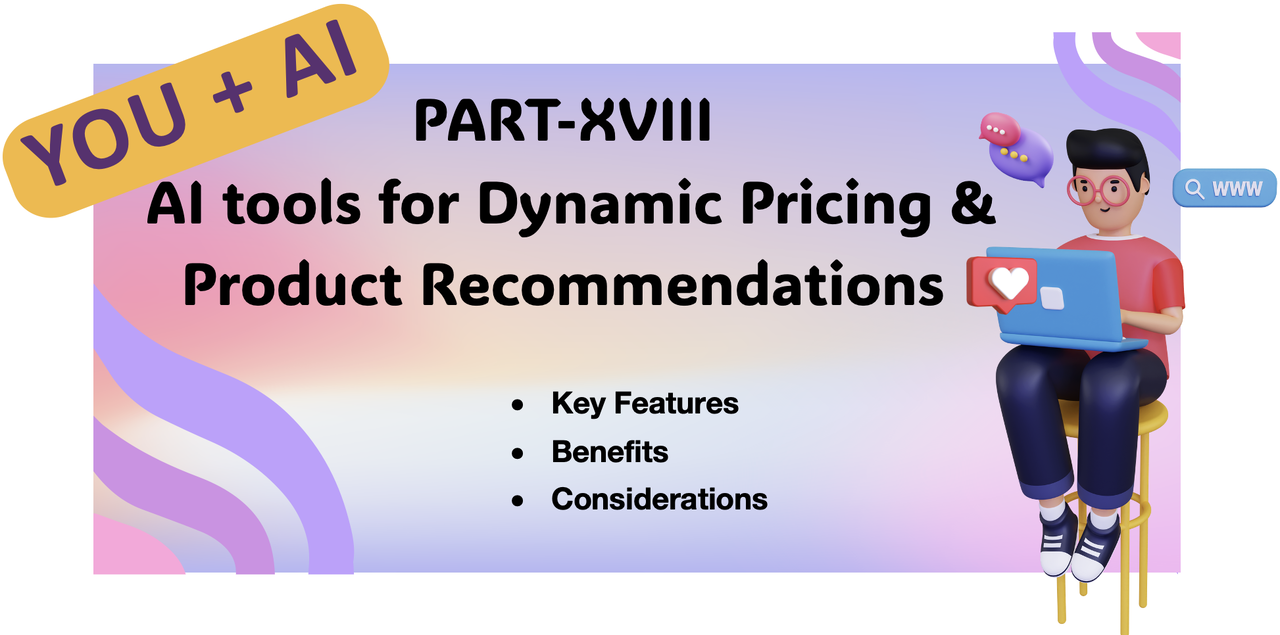
You+AI: Part XVIII: Dynamic Pricing & Product Recommendations

Dynamic pricing, the practice of adjusting prices in real-time based on various factors such as demand, competition, and market conditions, has been around for decades. One of the key advantages of AI-based dynamic pricing is its ability to personalize prices for individual customers. By leveraging data on past purchases, browsing history, demographics, and even psychographic profiles, retailers can tailor prices to match each customer’s willingness to pay. This not only maximizes revenue but also enhances customer satisfaction by offering fair and personalized pricing.

AI-based product recommendations are not limited to just online channels, retailers can seamlessly integrate AI-powered recommendations across various touchpoints, including websites, mobile apps, email campaigns, and even in-store displays. This omnichannel approach ensures a consistent and personalized shopping experience across all channels, thereby maximizing customer engagement and loy

Top AI-based Dynamic Pricing & Product Recommendations tools

Prisync (Dynamic Pricing)

  • Key Features: Real-time competitor price tracking and automatic price adjustments based on market conditions, demand signals, and competitor behavior.
  • Benefits: Increased revenue and profitability, improved competitive advantage, reduced manual pricing tasks.
  • Considerations: Requires accurate product data and integration with your e-commerce platform.

Pricefx (Dynamic Pricing)

  • Key Features: Advanced pricing algorithms, AI-driven demand forecasting, and customer segmentation for personalized pricing strategies.
  • Benefits: Optimized pricing across channels, improved conversion rates, increased customer satisfaction.
  • Considerations: Complex software requiring technical expertise, high pricing for enterprise-level features.

Zilliant (Dynamic Pricing)

  • Key Features: Machine learning-based price optimization, profit maximization algorithms, and dynamic bundling capabilities.
  • Benefits: Improved margins, increased sales volume, data-driven pricing decisions.
  • Considerations: Primarily focused on B2B pricing, high implementation costs.

Rebuy (Product Recommendations)

  • Key Features: AI-powered product recommendations based on user behavior, purchase history, and browsing activity.
  • Benefits: Increased customer engagement, improved conversion rates, personalized shopping experiences.
  • Considerations: Requires integration with e-commerce platform and customer data, may require customization for specific needs.

Twilio Segment (Product Recommendations)

  • Key Features: Real-time product recommendations across multiple channels, including email, SMS, and website pop-ups.
  • Benefits: Personalized marketing campaigns, increased customer lifetime value, improved cross-selling and upselling opportunities.
  • Considerations: Requires integration with CRM and marketing automation platforms, may require technical expertise.

.Coveo Personalized Recommendations (Product Recommendations)

  • Key Features: AI-powered product recommendations for search results, content pages, and email marketing campaigns.
  • Benefits: Improved website navigation, increased click-through rates, enhanced customer engagement.
  • Considerations: Requires integration with website platform and content management system, may require customization for specific needs.

Oracle CX Recommendations (Product Recommendations)

  • Key Features: AI-powered product recommendations across various Oracle CX solutions, including marketing automation and e-commerce platforms.
  • Benefits: Personalized customer experiences, increased conversion rates, improved marketing campaign ROI.
  • Considerations: Requires Oracle CX suite subscription, may be complex to set up and manage.

Additional factors to consider when choosing an AI-based Dynamic Pricing & Product Recommendations tool:

  • Industry and business needs: Consider the specific needs of your industry and business model when choosing a tool.
  • Data availability and quality: Ensure the tool can access and process your customer data effectively.
  • Technical expertise and resources: Evaluate the level of technical expertise required to implement and manage the tool.
  • Budget and pricing model: Compare the pricing models of different tools and choose one that fits your budget.
  • Scalability and flexibility: Consider the tool’s ability to scale with your business growth and adapt to changing needs.

By harnessing the power of AI, retailers can stay ahead of the competition, delight customers, and thrive in an increasingly complex and competitive marketplace. As AI technology continues to evolve, the possibilities for innovation and transformation in retail are virtually limitless.