The “You + AI” article series has been a collaborative voyage into a future teeming with challenges and opportunities. Throughout the journey, we delved deep into the ways AI is reshaping product and project development, as well as its personal and professional impacts. Across 24 articles, we navigated through various tools, frameworks, and strategies for integrating AI into our everyday work practices.
In addition to practical applications, the series also dedicated 25 articles to exploring the ethical considerations, risks, and opportunities posed by AI. We examined the potential threats and discussed ways to mitigate them, ensuring that as we embrace AI, we do so responsibly and with foresight. Through this comprehensive exploration, we aimed to equip readers with the knowledge and insights needed to navigate the evolving landscape of AI integration effectively.
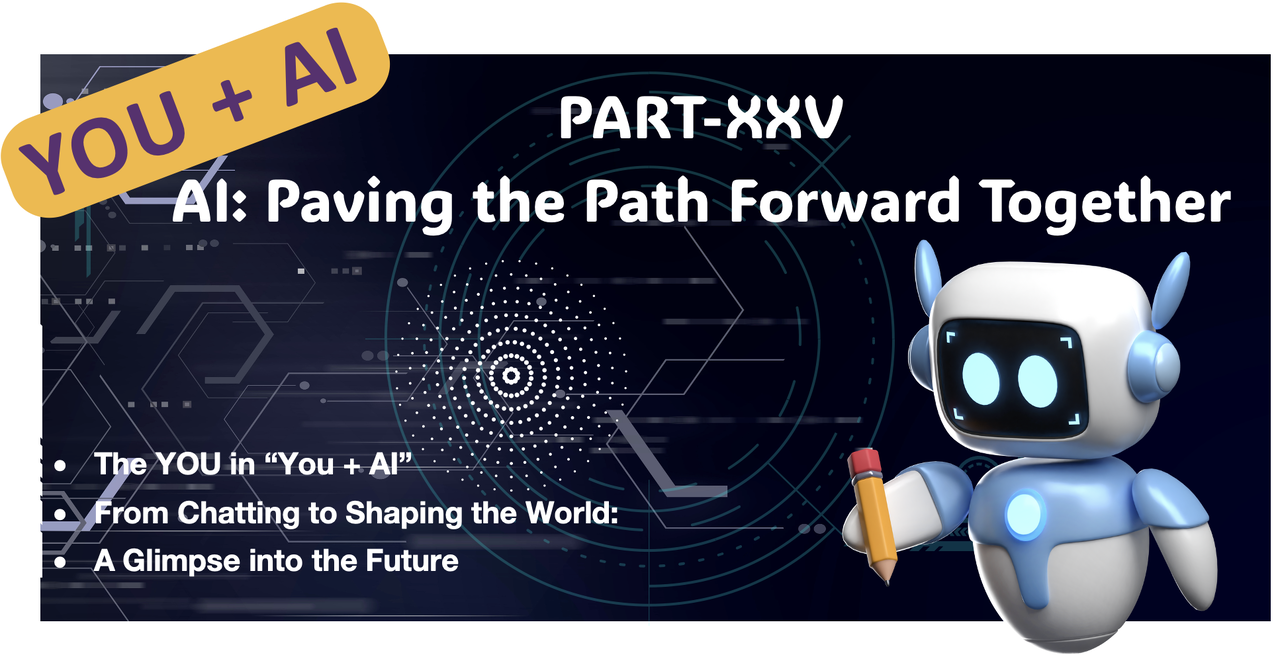
The YOU in “You + AI”
The future of AI is not predetermined; it’s a story we write together. As individuals, we can shape this narrative by:
- Embracing Lifelong Learning: Continuous learning will be key to thriving in a rapidly evolving world.
- Demanding Ethical AI: Hold companies and institutions accountable for developing and deploying AI responsibly.
- Contributing to the Conversation: Engage in discussions about the future of AI, ensuring everyone has a voice in shaping this powerful technology.
From Chatting to Shaping the World:
After ChatGPT, AI didn’t just get better at conversations; it started touching every part of our lives. It helps us predict trends in finance, improve healthcare, and make many things more efficient. As AI keeps growing, it’s not just one thing anymore. It’s a mix of different technologies working together. Think of it as a conductor leading a symphony, but instead of musicians, it orchestrates computers and devices to create something amazing.
The Evolving Partnership:
Fast forward to today, 2024. LLMs have become ubiquitous. They power our virtual assistants, personalize our news feeds, and even assist doctors with medical diagnoses. The initial fear of AI replacing humans has largely subsided. Instead, a collaborative approach has taken root.
Consider a doctor utilizing an LLM to analyze patient data and generate preliminary reports. The doctor, armed with this information, can then focus on personalized patient interaction and complex decision-making. This synergy exemplifies the future of human-AI collaboration.
The Challenges We Face:
This path isn’t without its hurdles. Bias in training data can lead to discriminatory outputs from LLMs. The potential for misuse of this technology for malicious purposes is a concern. The question of job displacement due to automation looms large. Addressing these challenges will require a multi-pronged approach:
- Ethical Development: Robust ethical frameworks for LLM development and deployment are crucial. Transparency in training data and algorithms is essential to mitigate bias.
- Reskilling and Upskilling: As AI automates tasks, human workers will need to develop new skills to stay relevant. Educational programs need to adapt to equip individuals for the jobs of tomorrow.
- Regulation and Oversight: Governments worldwide will need to establish regulations to prevent the misuse of AI and ensure the responsible development of this powerful technology.
A Glimpse into the Future:
Let’s take a leap forward and imagine the year 2030. AI has permeated every facet of our lives.
- Personalized Education: AI tutors tailor learning experiences to individual student needs, bridging learning gaps and fostering deeper understanding.
- Augmented Creativity: AI assists artists, writers, and musicians in their creative endeavors, generating ideas, brainstorming concepts, and refining artistic output.
- Scientific Breakthroughs: AI becomes a powerful tool for scientific discovery, analyzing vast datasets, simulating complex scenarios, and accelerating research and development.
Looking Ahead:
So, what does the future hold? Well, imagine AI that can solve problems even faster than it does now. That’s where quantum AI comes in. It’s like giving AI superpowers, allowing it to tackle complex challenges beyond our current abilities. Then there’s neuromorphic AI, which mimics how our brains work. This could lead to AI that thinks more like us, opening up new possibilities in how we interact with technology.
In the realm of creativity, AI is becoming quite the artist. It can compose music, create art, and even tell stories. Imagine collaborating with AI to bring your wildest ideas to life. It’s like having a creative partner who’s always full of fresh ideas.
As I wrap up our exploration of “You+AI” series, we stand on the brink of an exciting future. The lines between human and machine are blurring, and new opportunities await. But as we journey forward, let’s remember to tread carefully, keeping in mind our values and the well-being of all. With AI as our ally, we can become a force for positive change with AI empowering us to build a brighter future for generations to come.